






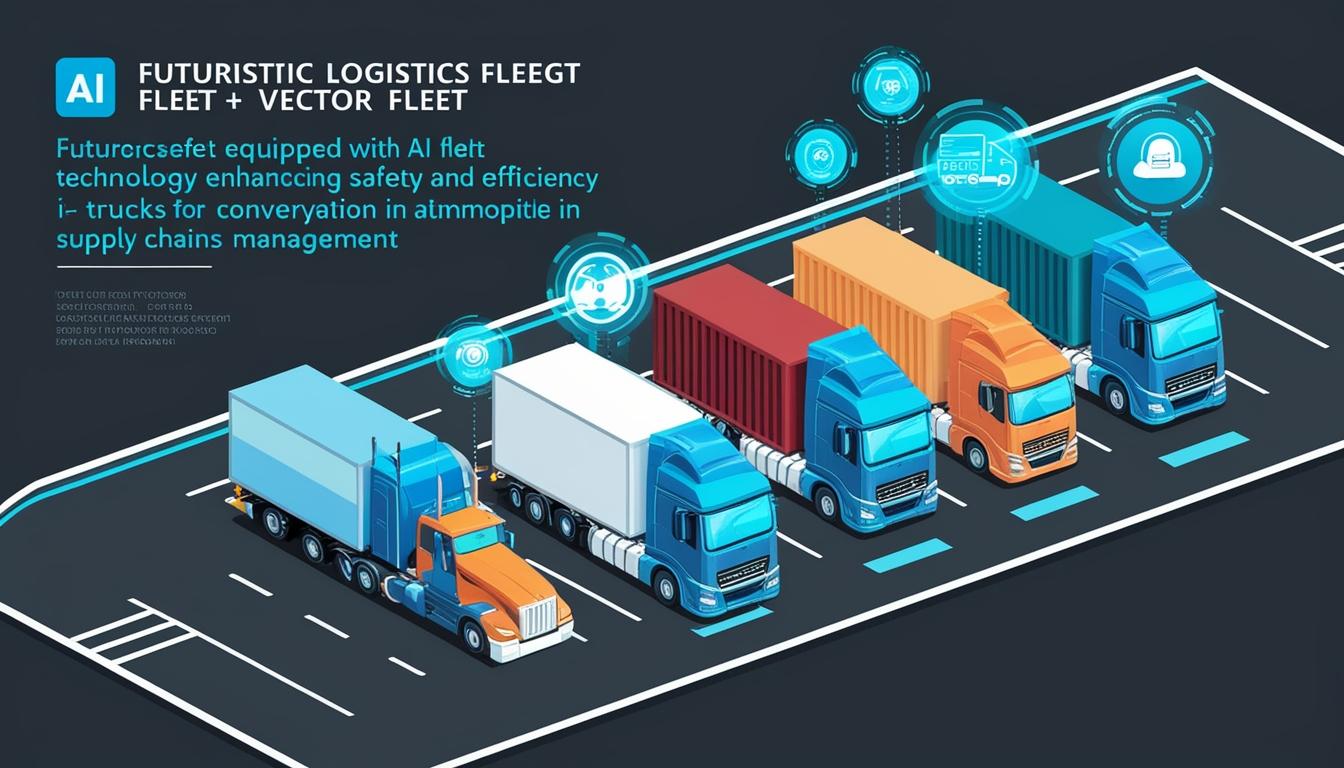

A recent study reveals that artificial intelligence could significantly enhance fleet safety and operational performance in the logistics sector, with a growing number of companies planning to adopt AI technologies within the next year.
Artificial Intelligence Poised to Revolutionise Fleet Safety in Supply Chain Logistics
In a recent study conducted by Netradyne during the Gartner Supply Chain Planning Summit, it was found that artificial intelligence (AI) holds significant untapped potential to enhance fleet safety, thereby increasing precision and profitability within supply chain logistics and transportation. Despite currently, only 33% of logistics operators utilising AI tools to assess and monitor fleet safety, a substantial 81% have expressed plans to integrate AI platforms over the next year. This move is aimed at mitigating risks and bolstering safety, which could lead to improved operational performance across the industry.
Key Challenges in Logistics and Transportation
The survey delves into the primary challenges faced by third-party logistics providers. According to the findings, 57% of supply chain professionals consider accuracy a top priority in goods delivery, while 31% emphasise timeliness and cost-effectiveness. Still, achieving these goals remains problematic, largely due to issues such as inadequate fleet visibility and limited availability of drivers—two factors that continue to impede delivery accuracy.
Accidents represent another significant hurdle, affecting not just the physical commodities by causing potential damage during transit, but also the overall image of brands involved. Additionally, they negatively impact driver well-being and availability, subsequently inflating costs. Concerningly, 46% of respondents admitted to being uncertain about the overall financial repercussions that accidents have on their respective businesses.
Technological Constraints on Data Accuracy
The relevance of accurate data in efficient fleet management and safety implementation cannot be overstated, with 52% of respondents already sharing information with partners to bolster safety standards. Nevertheless, the dependency on outdated technologies, such as telematics and GPS, has left much to be desired in terms of functionality. As indicated by the anticipated increase in AI adoption, there is a growing recognition among supply chain teams of the superior precision and insights provided by AI-driven data.
AI: The Future of Safer, More Efficient Fleet Operations
AI-driven solutions bring remarkable advantages to the logistics sector by markedly improving delivery precision and punctuality. They enhance fleet visibility and ensure better management of driver resources. Moreover, AI systems can analyse data to predict and prevent potential accidents, reduce traffic violations, and improve driver conduct. Through data-driven fleet engagement, AI is set to contribute to the creation of safer and more efficient fleet operations. For third-party logistics providers (3PL), this means more effective oversight and control, along with notable cost reductions, which directly contribute to increased profitability.
Durgadutt Nedungadi, Senior Vice-President for International Business at Netradyne, commented, “Transportation is an inherently tough business. With more people on the road and unpredictable conditions, there is more risk for logistics providers than ever.” He highlighted the growing pressures from increased customer expectations for swift, trouble-free deliveries and from insurers who are becoming more choosy. Nedungadi further noted, “Visibility in fleet operations is crucial to managing these challenges, and AI is proving to be a key tool for improving it.”
He concluded that vision-based AI technologies offer viable solutions to these challenges by providing real-time insights that enhance safety, predict potential issues, and allow for timely interventions. As the industry increasingly leans towards complexity, supply chain leaders are turning to AI-driven data analysis to not only boost operational efficiency but also maintain a competitive edge in an ever-evolving market landscape.
This focus on innovation and AI integration signals a transformative shift in logistics, with the potential to redefine safety and efficiency standards industry-wide.
Source: Noah Wire Services
More on this & sources
- https://www.logisticsbusiness.com/it-in-logistics/ai-iot/research-highlights-untapped-potential-of-ai-to-boost-fleet-safety/ – Corroborates the study by Netradyne on the untapped potential of AI to enhance fleet safety and the plans of logistics operators to integrate AI platforms.
- https://www.logisticsbusiness.com/it-in-logistics/ai-iot/research-highlights-untapped-potential-of-ai-to-boost-fleet-safety/ – Supports the key challenges faced by third-party logistics providers, including accuracy, timeliness, and cost-effectiveness, as well as issues like inadequate fleet visibility and limited driver availability.
- https://www.logisticsbusiness.com/it-in-logistics/ai-iot/research-highlights-untapped-potential-of-ai-to-boost-fleet-safety/ – Highlights the impact of accidents on logistics operations, including product damage, brand image, driver well-being, and costs, and the uncertainty about financial repercussions.
- https://www.logisticsbusiness.com/it-in-logistics/ai-iot/research-highlights-untapped-potential-of-ai-to-boost-fleet-safety/ – Discusses the limitations of outdated technologies like telematics and GPS and the growing recognition of AI-driven data’s precision and insights.
- https://www.link-labs.com/blog/ai-vs.-fleet-tracking-which-is-better-for-supply-chain-management – Explains how AI-driven solutions improve delivery precision, fleet visibility, and driver resource management, and predict and prevent accidents.
- https://www.link-labs.com/blog/ai-vs.-fleet-tracking-which-is-better-for-supply-chain-management – Details the integration of AI with fleet tracking to optimize routes, enable predictive maintenance, improve safety and compliance, and foster better communication and coordination.
- https://www.sdcexec.com/transportation/fleet-management/article/22917631/eroad-how-ai-is-reshaping-transportation-and-logistics-and-why-its-good – Supports the role of AI in improving safety through advanced driver-assistance systems and video telematics, and in enhancing cold chain logistics and overall supply chain efficiency.
- https://www.sdcexec.com/transportation/fleet-management/article/22917631/eroad-how-ai-is-reshaping-transportation-and-logistics-and-why-its-good – Highlights AI’s ability to simulate scenarios, predict future trends, and identify areas for improvement, aiding in decision-making and risk reduction.
- https://www.geotab.com/blog/ai-fleet-management-efficiency-safety/ – Explains how AI improves operational efficiency by analyzing real-time data, optimizing routes, and predicting maintenance needs, thus enhancing safety and reducing costs.
- https://www.geotab.com/blog/ai-fleet-management-efficiency-safety/ – Details AI’s role in improving driver safety through monitoring and predictive analytics, and in using unified data for better decision-making.
- https://www.forbes.com/sites/timothypapandreou/2024/04/18/from-analog-to-algorithm-how-ai-is-transforming-fleet-management/ – Supports the transformative impact of AI on fleet management, including unifying disparate data, predictive maintenance, real-time route optimization, and personalized driver coaching.







