






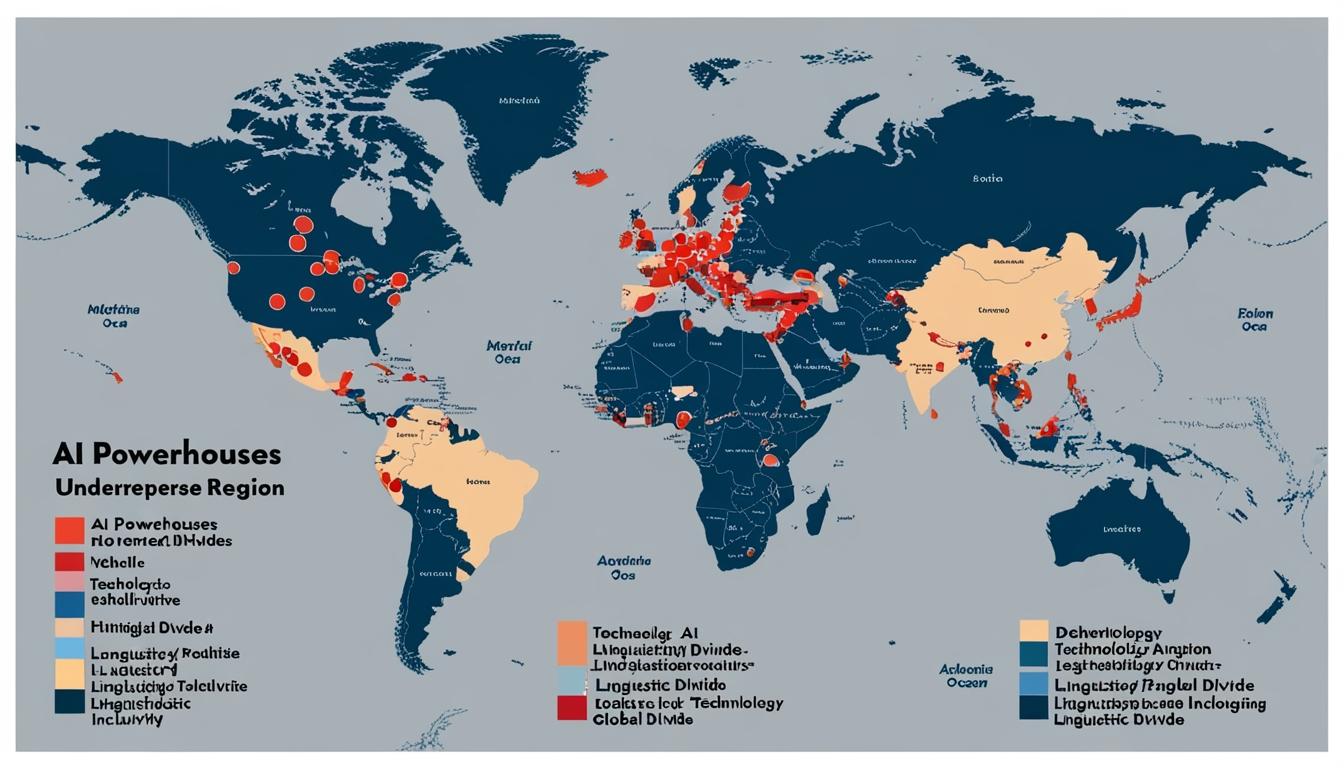

A closer look at the concentration of AI development among a few nations raises concerns over inclusivity and representation for diverse linguistic communities around the world.
AI Disparities Highlight the Global Divide in Technological Advancements
In the complex realm of artificial intelligence (AI), a distinct concentration of development and benefits is evident, with only a handful of nations currently reaping the rewards. This elite group, referred to as the “Compute North” by the Oxford Internet Institute, includes the United States, the United Kingdom, France, Canada, and China. These countries have positioned themselves at the forefront of AI innovation thanks to their robust research and development capacities and cutting-edge infrastructure. This advantage is underpinned by their status as hosts to prestigious universities and major technology firms.
However, this concentration of AI advancement raises significant concerns regarding inclusivity and representation. It has become apparent that billions residing outside these dominant spheres are often overlooked, predominantly those from diverse cultural backgrounds and languages not widely supported by mainstream AI platforms.
One clear indicator of this disparity is the performance of large language models (LLMs). Predominantly trained and optimised for English, Chinese, and a few other European languages, these models, including popular ones, exhibit notable limitations when applied to the wide spectrum of the world’s languages. Currently, there are approximately 6,000 languages in existence, many prevalent in regions such as Africa, Asia, and South America. Languages like Arabic, with roughly 400 million speakers, and Hindi, spoken by about 575 million people globally, often receive insufficient attention.

Recent evaluations underscore this linguistic gap. As an illustration, OpenAI’s LLaMA 2 model demonstrates a performance differential of up to 50% in English over Arabic, according to assessments using the LM-Evaluation-Harness framework. In contrast, Jais, a large language model co-developed by the Mohamed bin Zayed University of Artificial Intelligence (MBZUAI), shows superior performance in Arabic and is competitively on par with Meta’s models in English.
Addressing this disparity necessitates the establishment of new institutions dedicated to serving the diverse linguistic communities worldwide. Learning from historical precedents offers a way forward, demonstrating how these centres of innovation developed. For instance, before Silicon Valley emerged as a technological powerhouse, it was largely an agricultural domain known as Santa Clara Valley. Stanford University’s strategic focus on electrical engineering and the subsequent governmental support through grants catalysed this transformation. This environment bred a culture of innovation and entrepreneurship resulting in global tech giants like Alphabet, NVIDIA, Netflix, and PayPal.
In parallel, contemporary efforts are underway to replicate such environments elsewhere. The Mohamed bin Zayed University of Artificial Intelligence stands as a pioneer in this new wave, pledging to form a technological nexus powered by academia. Positioned strategically at the crossroads of the East and West, MBZUAI aims to draw top global talent and furnish them with the necessary resources to advance AI research and development.
This reimagining of AI innovation landscapes aims to disperse technological benefits more equitably on a global scale, addressing the current imbalance and unlocking potential across untapped regions. By fostering academic prowess and technological infrastructure, these new hubs aspire to level the playing field and create AI tools that inclusively serve all language communities.
Source: Noah Wire Services







