





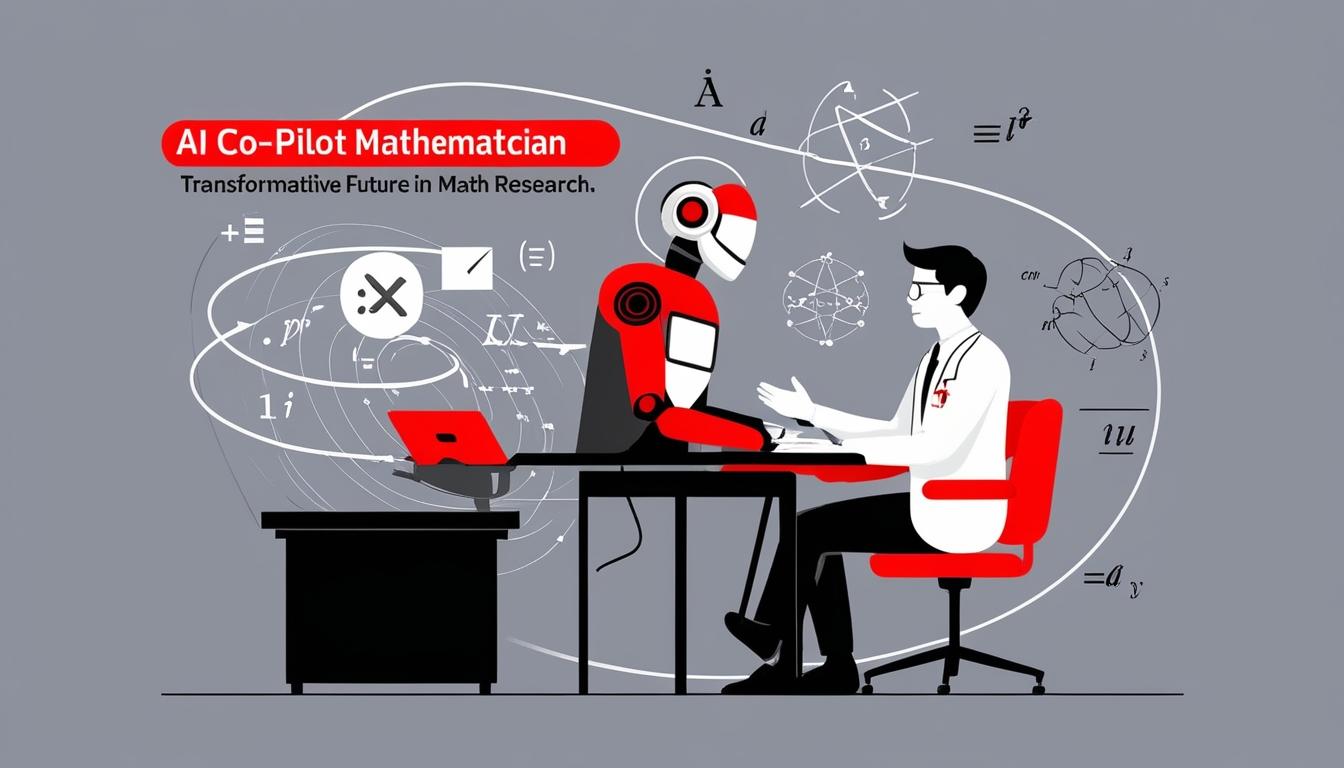

Recent advancements in artificial intelligence suggest a significant shift in how mathematicians approach complex problems, with AI systems aiding in the development and verification of mathematical proofs.
Recent advancements in artificial intelligence (AI) are set to transform the traditional methods of mathematical research, potentially enabling mathematicians to tackle complex problems that have long eluded human understanding. AI co-pilots, developed particularly at institutions such as the California Institute of Technology (Caltech), are making strides in assisting mathematicians by generating suggestions for proofs and providing new avenues for exploration within mathematical theorems.
At the forefront of this innovation is a large language model (LLM) designed to aid in the process of formal mathematical proof. This AI co-pilot can autonomously propose subsequent steps in the proof development process, facilitating the logical connections necessary to advance mathematical arguments. Animashree Anandkumar, a professor at Caltech, explains that the system offers multiple viable suggestions for moving forward, ensuring that all generated options are mathematically correct. This is achieved through the use of Lean, a software programme grounded in rigorous mathematical logic, which filters suggestions to guarantee validity.
The Lean proof assistant has gained traction within the mathematical community for its capacity to check the accuracy of statements entered by users—a marked departure from the typical informal mathematical review process, which is susceptible to human oversight. By coding their mathematics into Lean, users can generate statements that the software verifies automatically, eliminating the potential for errors that may arise in traditional proofs.
Anandkumar’s co-pilot allows mathematicians to request new lines of code to denote the mathematics they are working on, presenting a selection of tactic suggestions. While this approach offers a remarkable new tool for mathematicians, it does present a challenge since it requires coding numerical expressions and proof statements in a precise language, rather than the more fluid and familiar format of traditional mathematical notation. Martin Hairer, a professor at the Swiss Federal Institute of Technology and Imperial College London, acknowledges that the current adoption of this technology among mathematicians is not widespread, attributing this to the complexity involved in translating mathematical ideas into code.
However, Hairer also anticipates that AI co-pilots will relieve mathematicians of routine tasks, allowing them to focus on taking leaps into more intricate mathematical inquiries. Anandkumar notes a growing familiarity among young mathematicians with AI systems, suggesting a potential shift in mindset as the benefits of these tools become apparent.
The strides made by AI in the mathematical domain are not confined to basic operations; other notable systems, such as Google’s AlphaProof and AlphaGeometry 2, have showcased their ability to produce proofs at a commendable standard during prestigious competitions like the International Mathematical Olympiad. Yet, despite these successes, there remains a considerable gap between the capabilities of these systems and the requirements of professional mathematicians working on intricate proofs.
Google DeepMind’s David Silver expresses optimism for the future, suggesting that impending advancements will elevate the role of human mathematicians, allowing them to explore ideas and tackle problems at a heightened level of complexity. He draws parallels to the transformative impact of the electronic calculator on the field of mathematics, positing that AI could similarly revolutionise the proving process, easing the burden typically associated with complex mathematical reasoning.
Moreover, the integration of AI co-pilots may encourage a shift in the collaborative dynamics of mathematical research. Traditionally, mathematical work has been a solitary pursuit, often involving small teams exchanging feedback on proofs. The potential of AI tools to facilitate numerous partnerships between mathematicians and AI assistants could enable larger groups to divide major problems into manageable parts, fostering a more collaborative research environment.
Experts speculate that the collaboration of AI and human intellect might soon venture into the realm of notoriously difficult mathematical challenges, such as the Millennium Prize Problems—one of which, P versus NP, questions the relationship between problem verification and solution speed. Silver foresees a future where such complex problems may become more accessible, hinting at advancements that could emerge within a few years.
In conclusion, while the full integration of AI co-pilots into everyday mathematical practice remains on the horizon, the current developments indicate a significant transition in how mathematics may be conducted in the future. With AI’s growing capabilities poised to assist mathematicians, the field is on the brink of what could be a transformative era in problem-solving and mathematical exploration.
Source: Noah Wire Services
- https://the-decoder.com/renowned-mathematician-terence-tao-envisions-ai-powered-industrial-scale-mathematics/ – Supports the idea that AI can transform mathematical research by taking over routine tasks and enabling large-scale industrial collaboration, as envisioned by Terence Tao.
- https://mathscholar.org/2024/10/terence-taos-vision-of-ai-assistants-in-research-mathematics/ – Discusses Terence Tao’s vision of AI assistants in research mathematics, including the use of proof checkers and AI-based tools to facilitate collaboration and validate mathematical arguments.
- https://www.ams.org/about-us/governance/committees/2024_CoProf_white_paper.pdf – Explores the role of AI in assisting mathematicians with non-research and research tasks, such as drafting papers, improving accessibility of mathematical literature, and reviewing papers.
- https://www.mathvalues.org/masterblog/how-will-ai-impact-mathematics-research – Analyzes how Large Language Models (LLMs) can provide valuable assistance to human mathematicians in tackling major open problems and discusses the limitations of AI in mathematical discovery.
- https://the-decoder.com/renowned-mathematician-terence-tao-envisions-ai-powered-industrial-scale-mathematics/ – Highlights the potential of AI to relieve mathematicians of routine tasks, allowing them to focus on more intricate mathematical inquiries, aligning with Martin Hairer’s observations.
- https://mathscholar.org/2024/10/terence-taos-vision-of-ai-assistants-in-research-mathematics/ – Describes the use of Lean and other proof assistants to check the accuracy of mathematical statements, which is crucial for the integration of AI co-pilots in mathematical research.
- https://www.ams.org/about-us/governance/committees/2024_CoProf_white_paper.pdf – Mentions the potential for AI to assist in framing questions and searching for patterns in mathematical data, which could help in tackling complex problems like the Millennium Prize Problems.
- https://www.mathvalues.org/masterblog/how-will-ai-impact-mathematics-research – Draws parallels between the impact of electronic calculators and the potential impact of AI on the field of mathematics, as expressed by David Silver.
- https://the-decoder.com/renowned-mathematician-terence-tao-envisions-ai-powered-industrial-scale-mathematics/ – Discusses the collaborative dynamics of mathematical research and how AI tools could facilitate larger groups working on major problems, as envisioned by Terence Tao.
- https://mathscholar.org/2024/10/terence-taos-vision-of-ai-assistants-in-research-mathematics/ – Explains that AI co-pilots are seen as complementary tools that will not replace human mathematicians but rather assist them in their work, allowing for a focus on higher-level mathematics.
- https://www.ams.org/about-us/governance/committees/2024_CoProf_white_paper.pdf – Addresses the role of mathematicians in the public conversation around AI and the economic and professional implications of AI adoption in the field of mathematics.







