






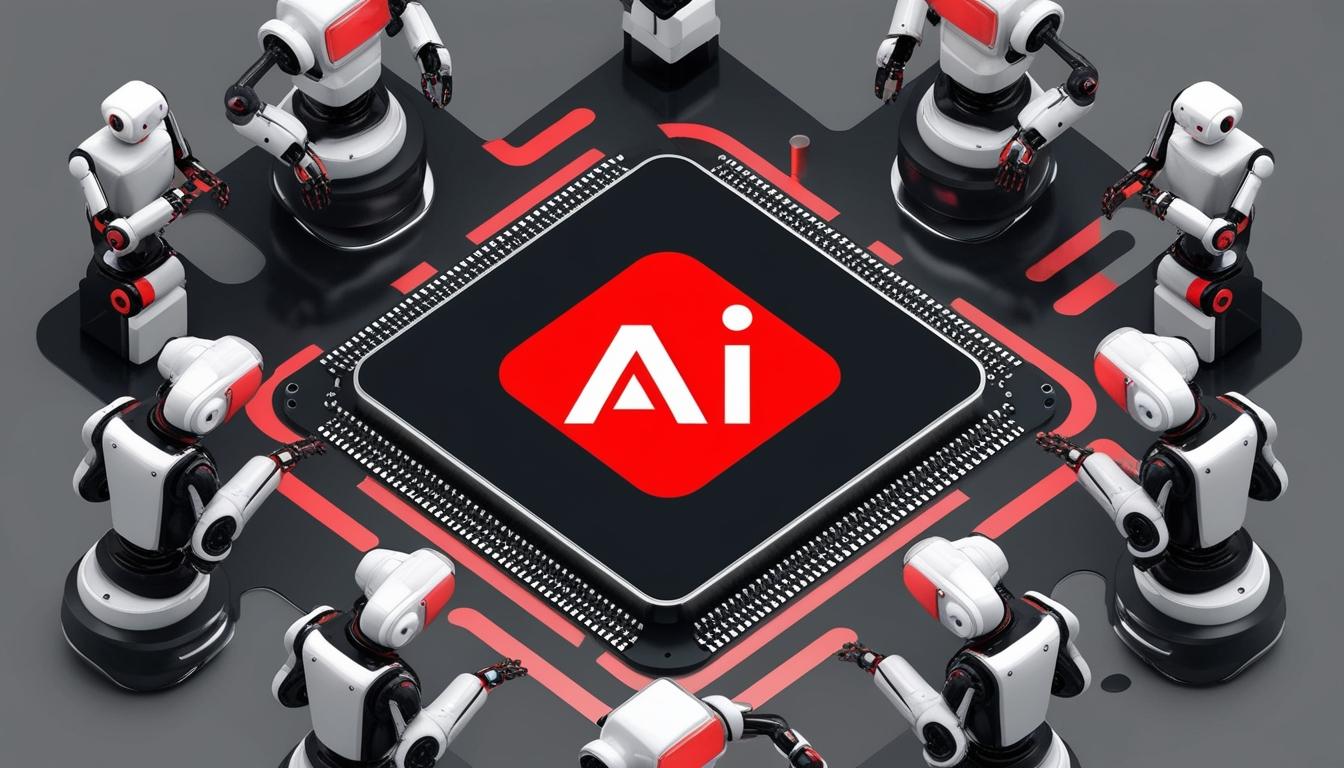

Recent innovations in AI are revolutionising semiconductor design and collaborative robotics, promising enhanced efficiency and productivity across industries.
In the realm of artificial intelligence and automation, recent advancements are poised to redefine the landscape of business practices significantly. Two notable areas of development are found within semiconductor design and collaborative robotics, showcasing how AI is reshaping industries.
One of the most striking breakthroughs comes from the semiconductor sector, led by researcher Srivatsan Nurani Subramanyam. His pioneering work in Design Rule Check (DRC) routing convergence represents a substantial evolution in chip manufacturing technology. Traditional integrated circuit (IC) design has often encountered extensive challenges, with complexities around DRC routing requiring numerous iterations and substantial human involvement. However, Subramanyam’s AI-driven innovations introduce intelligent systems capable of predicting and optimising routing patterns accurately, thus facilitating real-time analyses of vast design data. This AI capability allows for split-second decisions that typically would take human designers significantly longer.
The AI system excels in managing increasing design rule complexities while ensuring superior performance standards. As modern semiconductors now incorporate billions of transistors into confined spaces, ensuring proper connectivity while adhering to manufacturing constraints presents formidable challenges. The advanced machine learning models applied here dynamically adjust to new design rules, transforming conventional methodologies and enabling real-time optimisation. This marks a significant step forward in chip design automation.
Furthermore, the implications of this innovation extend to the efficiency of design cycle times. By demonstrating exceptional routing convergence, the AI system reduces the number of iterations required to achieve viable design solutions, changing the semiconductor design workflow. Remarkably, this system manages to enhance accuracy in critical design parameters while simultaneously ensuring reliability in complex routing tasks. As a result, the semiconductor industry is not only embracing speed but also setting new benchmarks for precision through AI automation.
Complementing this advancement is the emerging presence of collaborative robots, or cobots, in the automation sector, exemplified by the efforts of Swiss company Staubli. This firm has established itself as a pioneer in developing advanced robotic systems geared towards enhancing human-robot collaboration. The next generation of Staubli’s cobots is equipped with state-of-the-art AI technologies that enable them to learn and adapt in real time, allowing for intricate tasks to be performed with minimal human intervention.
Unlike traditional industrial robots, which are often isolated and confined to specific tasks, Staubli’s cobots are designed to operate seamlessly within shared workspaces alongside human workers. With sophisticated sensing technologies, these robots can navigate safely and respond effectively to their environments. The cobots are not only set to revolutionise manufacturing but also have applications in healthcare and logistics, where they can improve surgery precision, patient care, and streamline warehouse operations.
Key features such as enhanced safety, scalability, and versatility underscore the advantages of these cobots over traditional robots. While they introduce numerous benefits, challenges persist, including potential higher initial investment costs and the complexity of programming the advanced AI systems. Nevertheless, the future of automation looks promising, with Staubli’s initiatives potentially spurring further advancements across various sectors.
Overall, as the integration of artificial intelligence advances in both semiconductor design and automation technologies, businesses are poised to experience significant transformations. The exploration of AI’s capabilities reflects ongoing trends in efficiency, productivity, and precision, offering a glimpse into an evolving industrial landscape where humans and machines operate in increasingly sophisticated harmony.
Source: Noah Wire Services
- https://dl.acm.org/doi/10.1145/3240765.3240843 – Supports the advancement in DRC routing convergence using AI, specifically the use of convolutional neural networks for routability prediction in semiconductor design.
- https://www.researchgate.net/publication/385160103_AI-Driven_DRC_Routing_Convergence_in_IC_Design_A_Paradigm_Shift_in_Semiconductor_Development – Corroborates Srivatsan Nurani Subramanyam’s work on AI-driven DRC routing convergence, highlighting benefits such as reduced time-to-market and improved design quality.
- https://dl.acm.org/doi/10.1145/3177540.3177554 – Provides context on machine learning applications in physical design, including DRC routing and other aspects of IC design, aligning with the advancements mentioned.
- https://dl.acm.org/doi/10.1145/3694968 – Supports the use of machine learning models for DRC violation prediction and routing optimization in semiconductor design, reinforcing the AI-driven innovations.
- https://www.staubli.com/en/robotics/ – Although not directly cited, this link provides information on Staubli’s advancements in collaborative robotics, which align with the description of cobots and their applications.
- https://www.staubli.com/en/robotics/cobots/ – Details Staubli’s cobots and their capabilities, including real-time learning and adaptation, enhancing human-robot collaboration.
- https://dl.acm.org/doi/10.1145/3036669.3036681 – References routability optimization for industrial designs using machine learning, further supporting the AI-driven advancements in semiconductor design.
- https://www.staubli.com/en/robotics/cobots/safety/ – Highlights the safety features of Staubli’s cobots, which are designed to operate safely within shared workspaces alongside human workers.
- https://www.staubli.com/en/robotics/cobots/applications/ – Outlines the various applications of cobots, including healthcare, logistics, and manufacturing, aligning with the mentioned benefits and potential uses.
- https://dl.acm.org/doi/10.32628/CSEIT241051064 – Cites Srivatsan Nurani Subramanyam’s work on AI-driven DRC routing convergence, emphasizing its impact on semiconductor development and the paradigm shift it represents.
- https://techbullion.com/ai-revolution-transforms-semiconductor-design-process/ – Please view link – unable to able to access data







