





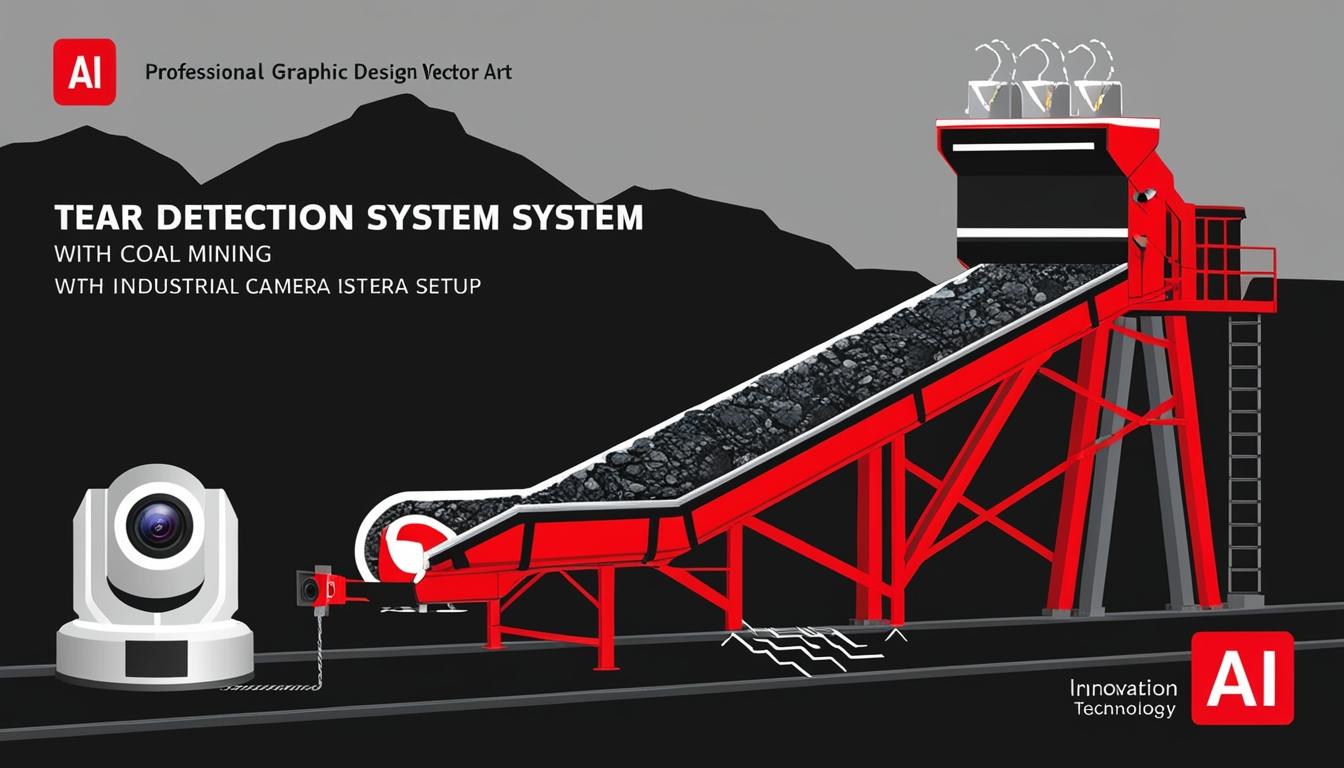

A new study reveals how AI-driven techniques enhance the detection of tearing defects in conveyor belts, improving operational efficiency in the coal mining sector.
Recent advancements in artificial intelligence (AI) and automation are indicated to significantly enhance operational efficiencies in various industries, with a particular focus on transportation systems such as conveyor belts particularly utilised in coal mining. A comprehensive study conducted by a research institute has introduced a specialised experimental platform aimed at examining the effectiveness of methods designed to detect tearing defects in these conveyor belts.
The study undertook foundational work to address a notable lack of available data concerning conveyor belt tearing within the coal mining sector. As a result, an experimental platform was meticulously designed to facilitate data acquisition and the production of specific datasets. The conveyor belt subjected to testing is characterised as a nylon rope core type (NN-300 L), measuring 800 mm in width and 8 mm in thickness, operating at a speed of 3 m/s. A CCD industrial camera (MV-CS050-20GM) equipped with a resolution of 2592 × 2048 pixels was employed for image acquisition, providing a frame rate of up to 22.7 fps.
To simulate realistic operating conditions and encompass various damage scenarios commonly encountered in the coal mining process, the researchers introduced several defect types. These included horizontal breaks and superficial scratches alongside longitudinal tearing, thus enhancing the robustness and reliability of the detection model. The initial dataset comprised 1,800 images, inclusive of 1,300 background images (where no tearing was present) and 500 images exhibiting tearing. Data augmentation techniques allowed for expansion of this dataset, yielding a total of 3,100 images divided into training, testing, and validation groups, ensuring a balanced representation of torn and non-torn images.
Within the experimental framework, model training was conducted using a Windows operating system with specifications including an Intel i5 12,400 F processor and an NVIDIA GeForce RTX3060Ti graphics card. The study utilised Python 11.3 and PyTorch 2.0.1 for its deep learning environment. This framework facilitated a meticulous evaluation of the model’s performance through a range of indicators, including accuracy, recall, F1 score, and mean average precision (mAP), which collectively reflected the detection capabilities of the developed approaches.

As part of the evaluation, the research adopted advanced mechanisms such as EfficientNet, BotNet, and SimAm to improve detection performance. Results indicated that the integration of these mechanisms within the Yolov5 framework yielded enhancements across various performance metrics, notably increased recall rates—3.8% with SimAm and the highest overall improvements attributed to the BotNet mechanism, which allowed for better data processing through parallel computation.
The study also compared various loss functions utilised within the detection model, aiming for superior results in precision and speed. The inclusion of Shape_IOU contributed to an increase in the model’s detection accuracy, demonstrating the significance of selecting appropriate computational strategies in machine learning frameworks.
The methodologies and findings of this research accentuate ongoing trends in artificial intelligence and machine learning within industrial applications. By refining detection capabilities in automated systems such as conveyor belts, the research aims to not only bolster operational efficiency but also adapt to the increasingly sophisticated technological landscape. The findings reflect a comprehensive understanding of how modern AI methodologies can evolve in conjunction with traditional industries, setting a benchmark for future research and operational enhancements.
Source: Noah Wire Services
- https://www.iieta.org/download/file/fid/140172 – This source discusses the application of AI technologies, including machine learning, computer vision, and IoT, to enhance the performance and safety of conveyor belt systems, particularly in industries like coal mining.
- https://pure.tudelft.nl/ws/portalfiles/portal/88572955/Longitudinal_tear_detection_method_of_conveyor_belt_based_on_audio_visual_fusion.pdf – This paper introduces an audio-visual fusion method for detecting longitudinal tears in conveyor belts, highlighting the use of image and sound features combined with machine learning algorithms for accurate detection.
- https://kr-asia.com/lenovos-ai-based-solution-unearths-new-efficiency-in-coal-mines – This article describes Lenovo’s AI-based solution for detecting abnormalities in conveyor chains in coal mines, using 3D visual recognition and low-light sensing, which improves maintenance efficiency and safety.
- https://www.iieta.org/download/file/fid/140172 – This source details the use of neural networks and other AI techniques for predicting belt tears and detecting defects in real-time, which aligns with the experimental platform’s goal of enhancing detection capabilities.
- https://pure.tudelft.nl/ws/portalfiles/portal/88572955/Longitudinal_tear_detection_method_of_conveyor_belt_based_on_audio_visual_fusion.pdf – The paper explains the experimental setup and data acquisition process using a CCD camera, which is similar to the setup described in the article for image acquisition and defect simulation.
- https://kr-asia.com/lenovos-ai-based-solution-unearths-new-efficiency-in-coal-mines – This article highlights the importance of automated inspection and the use of high-resolution cameras in coal mining, which is consistent with the article’s discussion on enhancing operational efficiencies through AI and automation.
- https://www.iieta.org/download/file/fid/140172 – The study mentioned here uses machine learning algorithms and deep learning models to evaluate the performance of conveyor belt defect detection, similar to the evaluation metrics mentioned in the article such as accuracy, recall, and F1 score.
- https://pure.tudelft.nl/ws/portalfiles/portal/88572955/Longitudinal_tear_detection_method_of_conveyor_belt_based_on_audio_visual_fusion.pdf – This paper discusses the use of data augmentation techniques to expand the dataset, which is also mentioned in the article as a method to ensure a balanced representation of torn and non-torn images.
- https://kr-asia.com/lenovos-ai-based-solution-unearths-new-efficiency-in-coal-mines – The article describes the integration of AI mechanisms to improve detection performance, such as Lenovo’s use of 3D visual recognition, which parallels the article’s discussion on using advanced mechanisms like EfficientNet and BotNet.
- https://www.iieta.org/download/file/fid/140172 – This source emphasizes the importance of selecting appropriate computational strategies in machine learning frameworks, such as the use of different loss functions, which is also discussed in the article.
- https://pure.tudelft.nl/ws/portalfiles/portal/88572955/Longitudinal_tear_detection_method_of_conveyor_belt_based_on_audio_visual_fusion.pdf – The paper highlights the significance of adapting to complex environments, such as those found in coal mines, which aligns with the article’s focus on refining detection capabilities in automated systems to adapt to sophisticated technological landscapes.







