





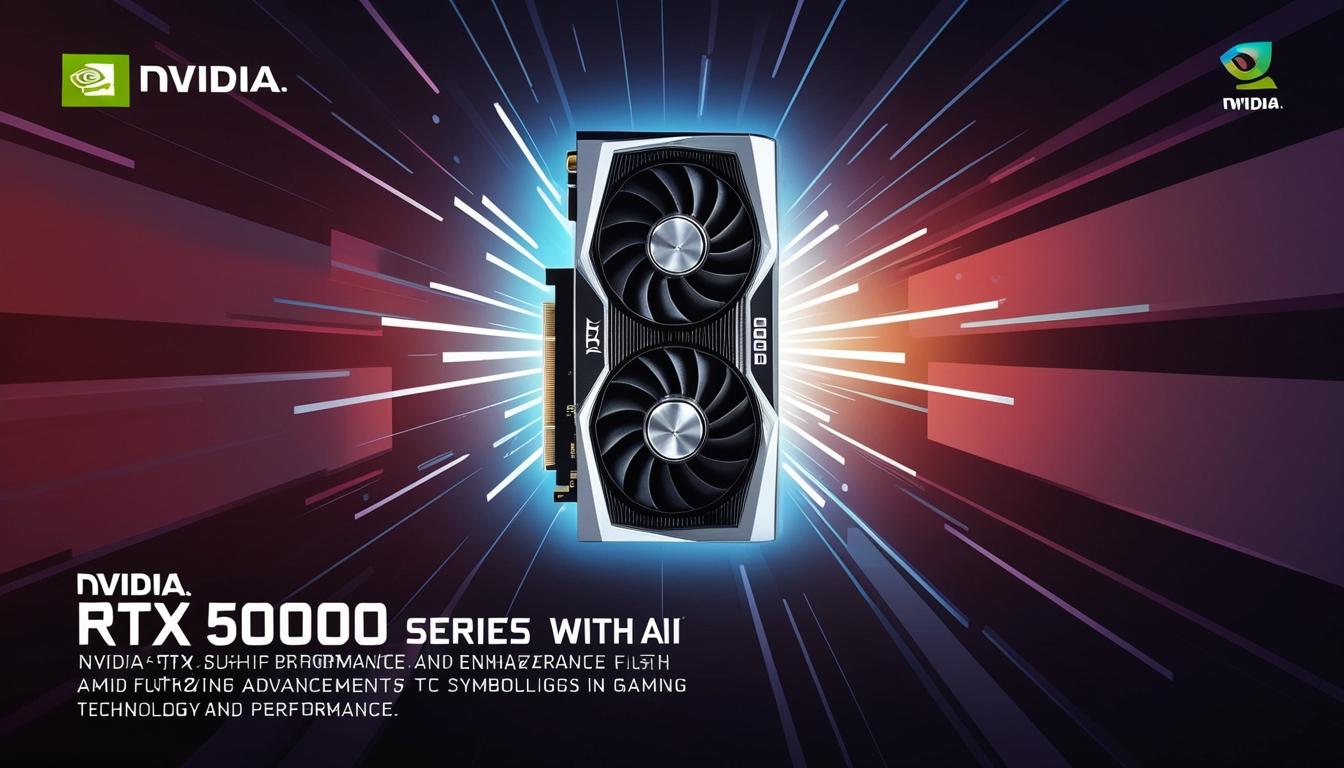

As Nvidia gears up for its RTX 5000 series launch and AMD transitions to AI-driven upscaling, Sony’s PlayStation 5 Pro promises significant enhancements, marking a pivotal moment in the gaming landscape.
Nvidia and AMD are on the verge of significant developments in the graphics processing unit (GPU) market as Nvidia prepares for the anticipated release of its RTX 5000 series and Sony’s PlayStation 5 Pro makes headlines with its new technological advancements.
Nvidia, a dominant player in the GPU market, is gearing up to launch its RTX 5000 series. This new release is set to build on the success of its current flagship, the RTX 4090, widely acclaimed for delivering unprecedented gaming performance. The upcoming series is expected to introduce the RTX 5090, along with improvements to Nvidia’s Deep Learning Super Sampling (DLSS), with the possible introduction of DLSS 4. This technology leverages artificial intelligence to enhance frame rates and image quality, particularly beneficial at higher resolutions with ray tracing enabled.
Meanwhile, AMD continues to hold its ground with its Radeon GPUs, such as the RX 7900 XT and XTX models, both noted for their capability to support a variety of games. However, a major shift is anticipated as AMD transitions to AI-driven upscaling with its future FSR 4, offering a significant technological step forward in competition with Nvidia’s DLSS. Unlike Nvidia’s approach, which is typically exclusive to its newest GPU models, AMD’s open-source design allows its FidelityFX Super Resolution (FSR) technology to be utilised across various platforms, including select Nvidia GPUs and Intel integrated graphics cards.
In parallel, Sony is set to release the PlayStation 5 Pro, featuring notable improvements in graphics rendering. This upgraded model promises a 45% increase in rendering speed, equipped with advanced ray tracing capabilities and an AI-assisted upscaling technology, dubbed PSSR (PlayStation Super Sampling Resolution). Sony’s lead systems architect, Mark Cerny, has hinted at unique ray tracing features exclusive to the PS5 Pro, potentially surpassing the capabilities of current AMD desktop GPUs.

The PS5 Pro aims to enhance the performance of over 8,500 games with specific improvements in ray tracing and PSSR, although only a limited number of games will have dedicated PS5 Pro enhancements at launch. A key feature suspected to underpin these advancements is denoising—a process essential for cleaning up ray-traced images—potentially integrated with AI similar to Nvidia’s Ray Reconstruction.
Sony’s strategy reflects a wider industry trend leveraging AI to boost graphical fidelity and performance on consoles, possibly offering a competitive edge over traditional gaming PCs. Despite this, the precise technical details and the broader implications of these features remain speculative until further concrete information emerges from Sony and AMD.
These developments highlight a critical juncture for both the gaming console and PC markets, marked by rapid advancements in GPU technology and AI-driven enhancements. As Nvidia, AMD, and Sony each push the envelope with their latest innovations, gamers and developers alike can anticipate a new era of high-performance gaming experiences, though the market dynamics and consumer preferences will ultimately shape the success of these technological endeavors.
Source: Noah Wire Services







