






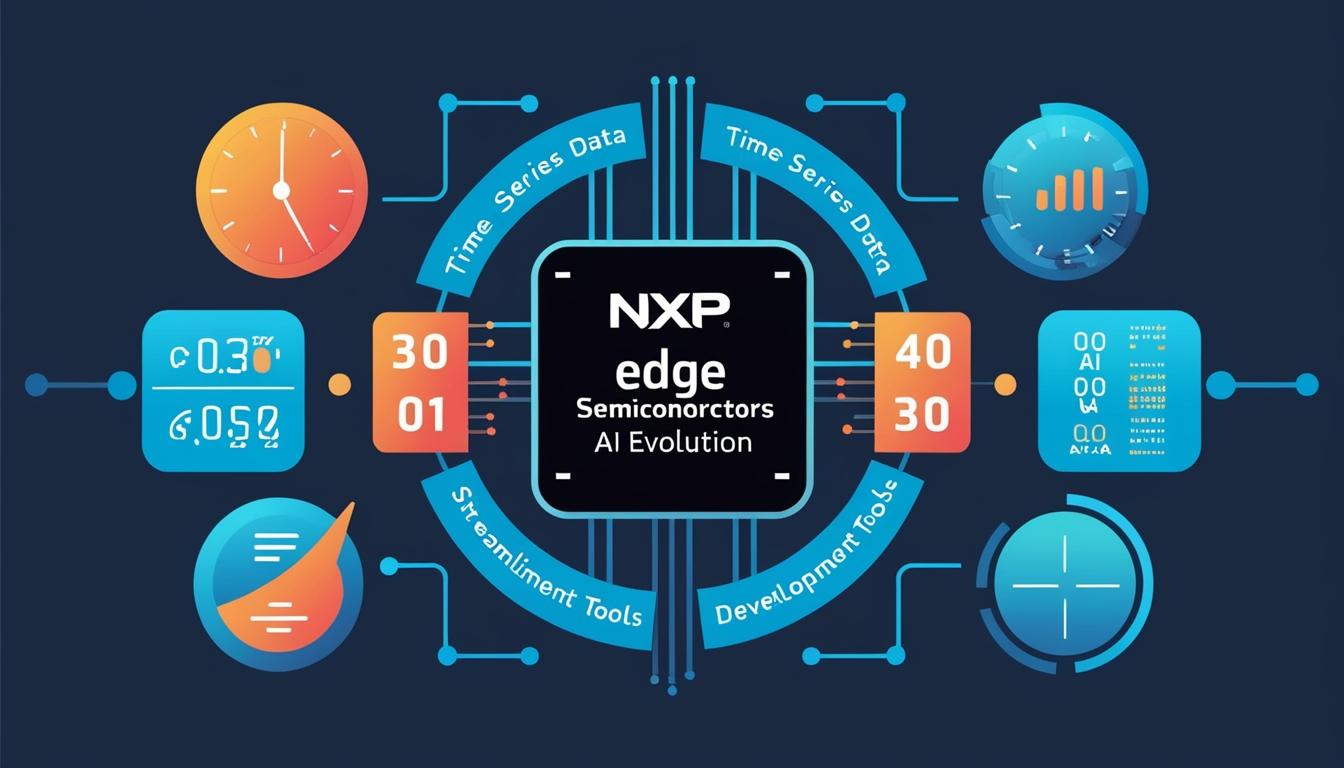

NXP Semiconductors introduces eIQ Time Series Studio and GenAI Flow, aiming to enhance the development and deployment of AI solutions on edge processors.
NXP Semiconductors has introduced two cutting-edge developments to its eIQ AI and machine learning development software aimed at enhancing AI deployment at the edge. The company has unveiled the eIQ Time Series Studio and GenAI Flow, both intended to streamline the processes of developing and deploying AI solutions across a diverse range of edge processors.
New Frontiers in Edge AI Deployment
The eIQ Time Series Studio is designed to simplify the creation of machine learning models that work on time series data, which includes sequences like temperature, pressure, sound, and more. This tool is particularly tailored for MCU-class devices, such as NXP’s MCX portfolio of microcontrollers and i.MX RT crossover microcontrollers. The software offers an automated machine learning workflow that significantly reduces the time and complexity involved in developing models intended for tasks such as anomaly detection, classification, and regression.
On the other hand, the GenAI Flow provides foundational components for creating Large Language Models (LLMs) tailored for specific applications. By allowing for fine-tuning with contextual data, this tool facilitates the deployment of sophisticated generative AI models on NXP’s i.MX family of application processors. This enables edge devices to support interactive user experiences, such as appliances capable of conversing about their features and maintenance in natural language.

Technological Advancements with Broad Implications
The benefits of deploying AI at the edge are numerous, offering reduced latency, enhanced user privacy, and lower energy consumption. With these new additions to its toolkit, NXP Semiconductors aims to make AI deployment more accessible and efficient. Developers are given more freedom to create varied model types, ranging from generative AI to time series and vision-based models, across a larger spectrum of edge processors.
Charles Dachs, senior vice president and general manager at NXP Semiconductors, commented on the significance of these developments, stating, “AI is the key to a world that anticipates and automates based on user wants and needs, but it must be developed in a way that is practical for edge deployment.” The tools introduced by NXP are positioned to offer a broad array of options for developers, enhancing the practicality and appeal of edge AI across various market applications.
Comprehensive Tools for a Wide Range of Applications
The eIQ Time Series Studio provides a robust development environment that includes data curation, visualisation, analysis, and the automatic generation, optimisation, emulation, and deployment of models. Its user-friendly interface empowers software developers to create libraries without extensive expertise in data science, making advanced AI development approachable for a wider audience.
Moreover, the GenAI Flow adds a layer of versatility to generative AI applications by optimising LLMs in a secure manner using Retrieval Augmented Generation (RAG). This approach allows for the fine-tuning of models on domain-specific information while maintaining privacy. The method is particularly significant for customers looking to cater AI solutions to specific tasks and optimise them for edge deployment using MPUs like the i.MX 95 processor.
By incorporating these innovations, NXP Semiconductors is working towards making AI an integral and practical component of modern edge computing systems, catering to evolving demands across industries.
Source: Noah Wire Services







