






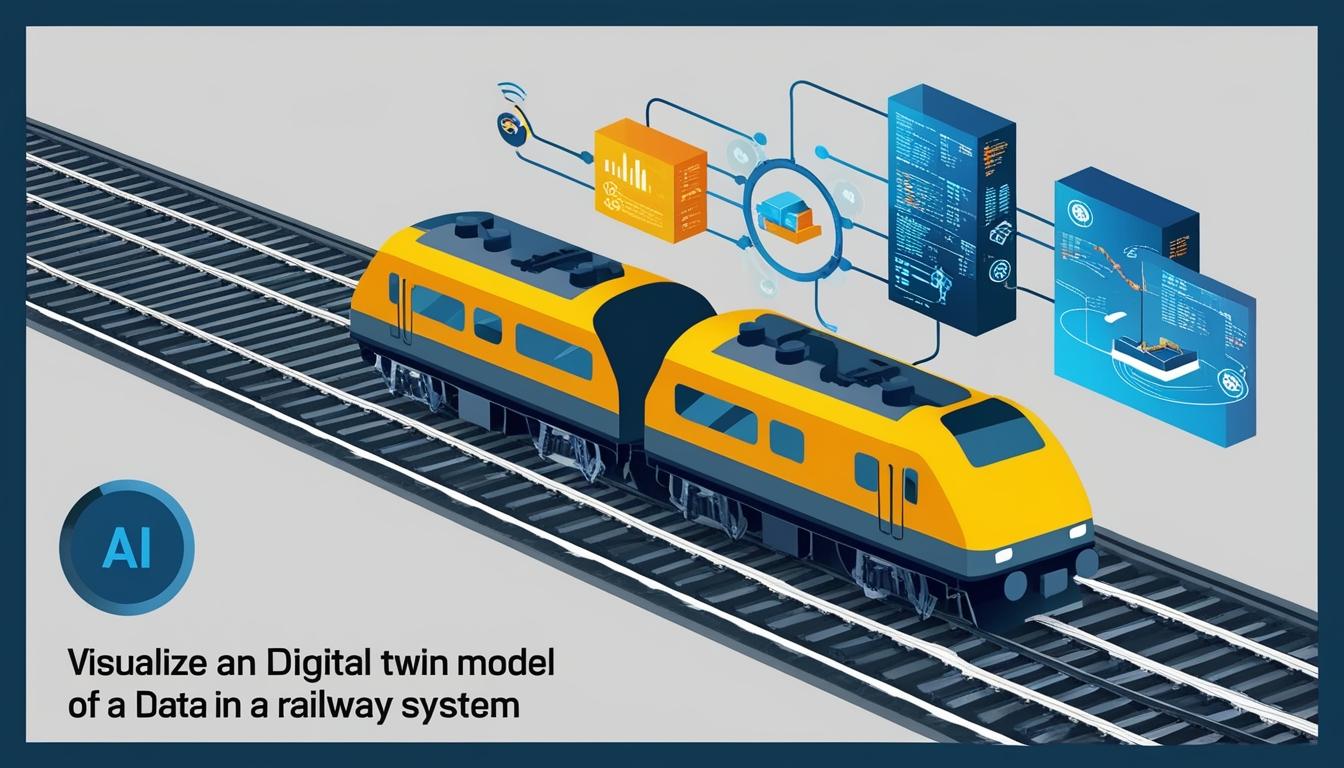

High Speed 1 and Network Rail High Speed are collaborating on an AI-driven digital twin project that promises to enhance efficiency and reduce costs in rail operations.
High Speed 1 (HS1) and Network Rail High Speed (NRHS) have taken significant strides towards enhancing efficiency and reducing costs in rail operations through the development and deployment of an artificial intelligence (AI) digital twin. This innovation is the result of a collaborative effort between Hexagon Consultants and Aerogility, a business specialising in AI-driven advanced enterprise digital twin technology, mainly utilised in the aviation sector.
The AI digital twin project was initiated to refine rail operations, maintenance, renewals, and inspection processes. According to HS1 and NRHS, the digital twin demonstrated its capacity to streamline these areas and effectively reduce asset management costs. The digital twin utilises data and processes to optimise planning and execution across various rail operations.
Richard Thorp, Chief Operating Officer of HS1, highlighted the value of this collaboration, noting that the partnership with Hexagon Consultants and Aerogility presented new challenges and insights into improving planning and delivery within the rail industry. He emphasized the trial’s potential value and noted how the project allowed the team to chart a clear, efficient, and achievable path towards transformation in terms of cost, performance, and safety.
Simon Miles, head of AI at Aerogility, explained the rationale behind integrating AI into the digital twin. He pointed out the complexity inherent in managing maintenance teams, equipment, and other logistical constraints on rail tracks, highlighting how AI facilitates the decision-making process by analysing vast amounts of data to provide optimal solutions.
Hexagon Consultants’ Managing Director Sue Williams described the evolution of HS1’s approach to asset management prior to the introduction of the digital twin. While HS1 and NRHS had been undertaking research and developing strategies focused mainly at the asset or equipment level, the new AI-driven model elevates the scope to an enterprise level, considering a broader array of variables for plan formulation and execution.
Aerogility’s AI technology stands apart from other AI models due to its distinct design, crafted entirely in-house. Unlike generative AI, which can produce incorrect results, Aerogility’s AI focuses on precision and reliability, essential for sectors such as aviation. The model developed for HS1 and NRHS provides a recommended plan that experts can refine based on their knowledge of current asset conditions, ensuring accuracy and safety in application.
The introduction of AI into digital twins also underscores the need for skilled personnel capable of leveraging such advanced technologies. Miles reiterated that while Aerogility is designed for use by non-technical tradespeople, sufficient training remains crucial due to its complexity. Williams also highlighted the importance of a process framework that enables users to understand and apply the technology within established boundaries, supported by governance and structure.
The tool’s regulatory compliance is another critical aspect, necessitating a clear data strategy to manage input data and ensure adherence to legal requirements. This underlines the importance of a comprehensive supporting framework for maintaining regulatory compliance.
Currently, the AI digital twin remains in the prototype phase, having proven its concept with HS1 and NRHS. Both organisations are now deliberating on future implementation strategies. Williams and her team anticipate the technology could see broader applications beyond rail, extending into wider transport infrastructure.
The initiative demonstrates the potential for AI and digital twins to transform traditional operational frameworks, offering new insights and solutions that could redefine transport infrastructure management in the future.
Source: Noah Wire Services







