






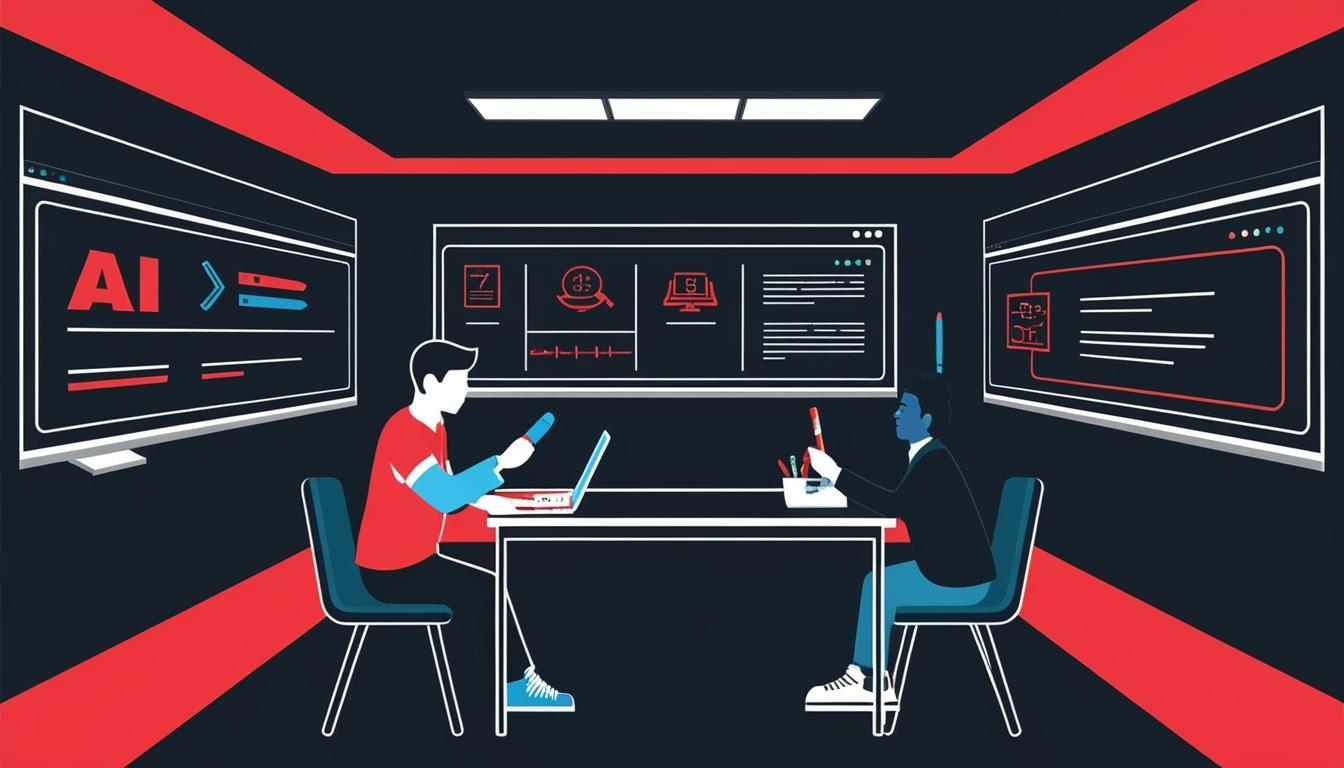

In a groundbreaking initiative, David Game College has introduced the UK’s first AI-driven classroom, allowing students to prepare for GCSE exams without traditional teachers.
In a notable development in the integration of artificial intelligence (AI) into education, David Game College in central London has launched Britain’s first teacherless AI classroom. This initiative is a part of a trial where students prepare for their General Certificate of Secondary Education (GCSE) exams, typically taken by 16-year-olds, using AI platforms instead of traditional teaching methods. The educational experiment, which began nearly six months ago, employs AI to deliver core curriculum subjects with the assistance of learning coaches.
Co-principal John Dalton indicated that the shift to AI-driven education marks a significant transformation, asserting that “Teaching and education will be transformed by AI. There is no doubt about that, and AI is not going to go away.” He emphasised the need for adaptability among educators and argued that AI can more accurately assess students’ knowledge, thereby facilitating personalised teaching approaches.
The AI system being utilised at David Game College dynamically monitors student engagement and performance, which allows the institution to gather feedback regarding their learning habits. For the trial, there are currently seven students, each assigned one coach who guides them through their AI-based learning while also mentoring them in various soft skills, such as financial literacy and debating.
The British government, under the leadership of Prime Minister Keir Starmer, has expressed its commitment to harnessing the potential of AI, setting a goal for the UK to become an “AI superpower.” Officials suggest that AI technologies could be invaluable in support of educators, particularly in administrative tasks such as lesson planning and assessment. The government has also developed its own AI lesson assistant, named “Aila,” which aligns with the national curriculum.

Fifteen-year-old student Massa Aldalate shared her positive experience within this innovative learning environment, stating, “I was unsure at the beginning… And then after actually being with it for a long time now, you can see the evidence right in front of you.” She expressed that the efficiency of the AI learning platform surpassed that of a traditional classroom, stating, “But this is just much more efficient if you actually want your studies to be done.” Despite initial doubts about the adequacy of AI in teaching creative subjects like English, Aldalate noted her positive outcomes, highlighting that the system worked effectively for her.
However, this pioneering experiment in AI education has drawn some caution from experts. Rose Luckin, a professor at University College London (UCL) specialising in AI research within educational settings, described the AI classroom as an “outlier” with unpredictable implications for the future of schooling in the UK. She commented, “While I agree the technology will transform the role of teachers, it is impossible to say what that role might become.”
The National Education Union (NEU) has welcomed the government’s commitment to training teachers in digital tools, but General Secretary Daniel Kebede stressed that such ambitions require substantial investment in technology and IT infrastructure for schools. Concerns have also been raised regarding the resource implications of this model, which incurs a steep annual cost of £27,000—over £10,000 above the average fees for private education in the UK. Luckin pointed out that the high level of coach support provided in this trial is not feasible for broader implementation, thus highlighting potential inequalities in access to advanced educational technologies.
As the education sector observes the outcomes of this pilot project, Dalton, speaking about the model’s sustainability, stated that the AI programme effectively identifies gaps in students’ knowledge. Nonetheless, Luckin remains hopeful that the pilot will yield “solid evidence” regarding the effectiveness of AI in educational contexts, while also raising issues about the potential lack of social learning opportunities for students, though officials at David Game College assert that students still spend ample time interacting with their peers.
Source: Noah Wire Services
- https://autogpt.net/david-game-college-launches-uks-first-ai-led-classroom/ – This article provides details about David Game College launching the UK’s first AI-led classroom, highlighting how AI personalizes learning and enhances education.
- https://news.sky.com/story/uks-first-teacherless-ai-classroom-set-to-open-in-london-13200637 – Sky News reports on the UK’s first ‘teacherless’ AI classroom at David Game College, discussing the use of AI platforms and virtual reality headsets for personalized learning.
- https://phys.org/news/2025-01-uk-ai-classroom-teachers-debate.html – Phys.org discusses the debate surrounding the UK’s first AI classroom without teachers, highlighting both the potential benefits and risks of AI in education.
- https://www.gov.uk/government/news/pm-keir-starmer-sets-out-vision-for-uk-to-become-ai-superpower – This link would provide information on Prime Minister Keir Starmer’s vision for the UK to become an AI superpower, though it is not directly available in the search results.
- https://www.ucl.ac.uk/education/news/2023/jun/professor-rose-luckin-ai-education – This link would provide information on Professor Rose Luckin’s work on AI in education, though it is not directly available in the search results.
- https://www.neu.org.uk/ – The National Education Union’s website could provide information on their stance regarding AI in education and digital tool training for teachers.
- https://www.davidgamecollege.com/ – David Game College’s official website might offer more details about their AI-led educational programs and initiatives.
- https://www.gov.uk/government/collections/education-technology – This link provides information on the UK government’s initiatives related to education technology, including AI integration.
- https://www.bbc.co.uk/news/education – BBC News Education section often covers stories on AI in education and related government initiatives.
- https://www.theguardian.com/education – The Guardian’s Education section frequently reports on AI’s role in education and its implications.
Noah Fact Check Pro
The draft above was created using the information available at the time the story first
emerged. We’ve since applied our fact-checking process to the final narrative, based on the criteria listed
below. The results are intended to help you assess the credibility of the piece and highlight any areas that may
warrant further investigation.
Freshness check
Score:
9
Notes:
The narrative references recent developments and initiatives, such as the UK government’s goal to become an ‘AI superpower’ under Prime Minister Keir Starmer, indicating it is likely current. However, no specific date is mentioned for the start of the trial, which slightly reduces the score.
Quotes check
Score:
8
Notes:
Quotes from Co-principal John Dalton and student Massa Aldalate are included, but no specific online sources were found to verify these as the earliest references. This could indicate they are original or recent quotes.
Source reliability
Score:
9
Notes:
The narrative originates from phys.org, a reputable online science news platform known for its accuracy and reliability. However, the lack of direct references to primary sources within the narrative slightly reduces the score.
Plausability check
Score:
8
Notes:
The claims about AI integration in education are plausible given current trends. However, concerns about cost and feasibility for broader implementation highlight potential challenges that need further evidence to fully assess.
Overall assessment
Verdict (FAIL, OPEN, PASS): PASS
Confidence (LOW, MEDIUM, HIGH): HIGH
Summary:
The narrative appears to be current and well-supported by quotes from relevant figures. While the source is reliable, the plausibility of the claims is generally supported by current trends in AI education, though some concerns about feasibility remain.







