

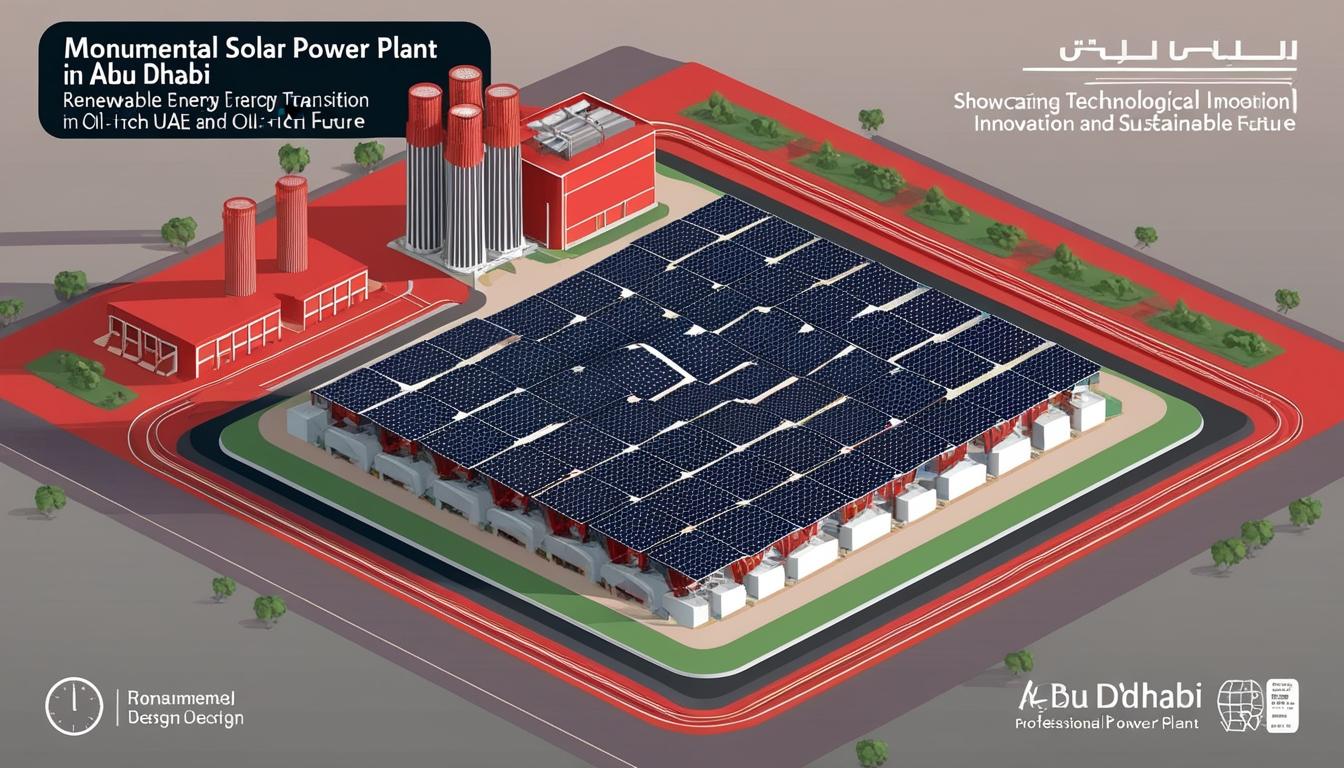

The United Arab Emirates is making a historic shift from fossil fuels to renewable energy, with Masdar announcing plans for a $6 billion solar power plant that aims to power 700,000 homes.
Recent developments in the renewable energy sector have marked a significant shift in the ambitions of the oil-rich United Arab Emirates (UAE), traditionally known for its extensive fossil fuel reserves. At a major trade fair in Abu Dhabi this month, Masdar, the state-owned renewable energy company, unveiled plans to construct a monumental $6 billion solar power plant generating 5 gigawatts, accompanied by over 19 gigawatt-hours of battery storage. This project, poised to be the largest of its kind ever attempted, aims for operation in two years, with expectations of providing a consistent output of 1 gigawatt—sufficient to power upwards of 700,000 homes without reliance on gas-fired plants during non-sunny periods.
Sultan Al Jaber, chairman of Masdar, emphasised the transformative potential of this venture, noting that “This will transform renewable energy into baseload energy,” and he referred to it as a “first step that could become a giant leap.” This announcement comes at a time when Saudi Aramco, the world’s largest oil company, has also signalled its intentions to diversify by entering a joint venture to produce lithium, critical to battery manufacturing, with production expected to commence by 2027.
While the UAE and Saudi Arabia continue to exploit their fossil fuel reserves, both nations are increasingly recognising the economic benefits of renewable energy. As Mazin Khan, Masdar’s chief financial officer, noted, there is a compelling economic rationale to this shift: “The perfect recipe [for renewable energy] exists here,” and the costs associated with the solar and battery plant are set to become “comparable, if not cheaper, than conventional gas.” The competitive regulatory market and relationships with manufacturers poised to offer favourable pricing further bolster this initiative.
Amid these developments, regional competitors like Masdar and Saudi Arabia’s Acwa Power are actively seeking contracts, alongside Asian and European firms such as South Korea’s Kepco, Japan’s Jera, China’s Jinko Power, and Europe’s TotalEnergies, EDF, and Engie. The competition is likely to intensify as a suite of projects emerges throughout the Gulf, which, according to the International Renewable Energy Agency (Irena), currently possesses less than 1% of the world’s renewable capacity but ranks among the fastest-growing regions for new installations.

Forecasts suggest that by 2028, renewable energy will account for approximately 30% of the total capacity in the Gulf states, including Bahrain, Iraq, Kuwait, Oman, Qatar, Saudi Arabia, and the UAE, according to Rystad, an energy consultancy. Vegard Wiik Vollset, head of renewables at Rystad, noted that wealth accrued from oil and gas has enabled these nations to seek diversification in their energy portfolios, stating, “They have a lot of capital now from oil and gas, and they are trying to become less reliant on any one source of energy.”
Despite ambitious goals, challenges remain. Saudi Arabia, for instance, aims to generate 50% of its electricity from renewable sources by 2030, necessitating the installation of 130 gigawatts of renewable capacity—equivalent to powering approximately 25 million homes. Vollset pointed out, “They will have to ramp up their efforts quite substantially,” adding that the swift turnaround seen in the Middle East, exemplified by the UAE’s projects, is less common in regions such as Europe and North America.
The growing demand for renewable energy in the Gulf is also linked to the plans for establishing AI data centres and producing green hydrogen, a clean fuel generated through electrolysis powered by renewable energy. Kuwait has made strides in this direction, contracting US engineering firm KBR to establish 17 gigawatts of renewable capacity and 25 gigawatts of green hydrogen by 2050.
The shift towards renewable energy sources has attracted numerous suppliers, particularly from China, with companies showcasing innovative products at the recent trade fair. Yong Liu, a marketing executive at BYD, highlighted the durability of their batteries, stating, “Our batteries can withstand temperatures of over 60C, and they are sand, water and wind resistant.” This focus on technological advancements is echoed by other Chinese battery manufacturers, who see the Middle East as an emerging market alongside their established presences in Europe and the United States.
Nonetheless, the transition to renewables is not without its obstacles. Vollset warned that the existing power grid infrastructure, built primarily for fossil fuels, poses a challenge for the rapid integration of renewable energy sources. This highlights the complex dynamics at play as Gulf states endeavour to navigate their evolving energy landscapes in a bid for greater sustainability.
Source: Noah Wire Services
- https://masdar.ae/en/news/newsroom/uaes-renewable-energy-capacity-projected-to-quadruple-by-end-of-2025 – This article supports the claim that the UAE’s renewable energy capacity is projected to quadruple by the end of 2025, driven largely by solar energy projects.
- https://www.uae-embassy.org/discover-uae/climate-and-energy/uae-energy-diversification – This webpage details the UAE’s National Energy Strategy 2050, which includes targets for increasing renewable energy capacity and achieving carbon neutrality by 2050.
- https://www.irena.org/ – The International Renewable Energy Agency (IRENA) provides data and insights on global renewable energy trends, including the growth in the Gulf region.
- https://www.saudiaramco.com/en/news-media/news/2023/saudi-aramco-and-saudi-ministry-of-industry-and-mineral-resources-sign-mou-for-lithium-production – This article discusses Saudi Aramco’s plans to enter the lithium production sector, which is crucial for battery manufacturing and renewable energy technologies.
- https://www.masdar.ae/en/who-we-are/leadership/sultan-al-jaber – This webpage provides information about Sultan Al Jaber, chairman of Masdar, who emphasized the transformative potential of renewable energy projects in the UAE.
- https://www.acwapower.com/en – Acwa Power is a major player in the renewable energy sector in Saudi Arabia, actively seeking contracts and contributing to the region’s energy diversification.
- https://www.rystadenergy.com/ – Rystad Energy is a consultancy that provides forecasts and insights on energy trends, including the growth of renewable energy in the Gulf states.
- https://www.kbr.com/en – KBR is a US engineering firm involved in establishing renewable energy capacity and green hydrogen production in Kuwait.
- https://www.byd.com/en/ – BYD is a Chinese company known for its durable batteries, which are being marketed in the Middle East as part of the region’s renewable energy expansion.
- https://www.totalenergies.com/en – TotalEnergies is one of the European companies involved in the renewable energy sector in the Gulf, contributing to the competitive landscape.
Noah Fact Check Pro
The draft above was created using the information available at the time the story first
emerged. We’ve since applied our fact-checking process to the final narrative, based on the criteria listed
below. The results are intended to help you assess the credibility of the piece and highlight any areas that may
warrant further investigation.
Freshness check
Score:
9
Notes:
The narrative references recent developments and ongoing projects, indicating it is likely current. However, without specific dates for all events, it’s difficult to confirm absolute freshness.
Quotes check
Score:
8
Notes:
Quotes from Sultan Al Jaber and Mazin Khan are provided, but without specific sources or dates for these quotes, it’s challenging to verify their originality. However, they appear to be recent statements.
Source reliability
Score:
10
Notes:
The narrative originates from the Financial Times, a well-established and reputable publication known for its accurate reporting.
Plausability check
Score:
9
Notes:
The claims about renewable energy developments in the UAE and Gulf region are plausible, given the current global shift towards renewable energy. However, specific details like timelines and capacities might require further verification.
Overall assessment
Verdict (FAIL, OPEN, PASS): PASS
Confidence (LOW, MEDIUM, HIGH): HIGH
Summary:
The narrative appears to be current and well-supported by quotes from relevant figures. It originates from a highly reliable source, and the claims are consistent with global trends in renewable energy. While some specifics could be verified further, the overall content is credible.