

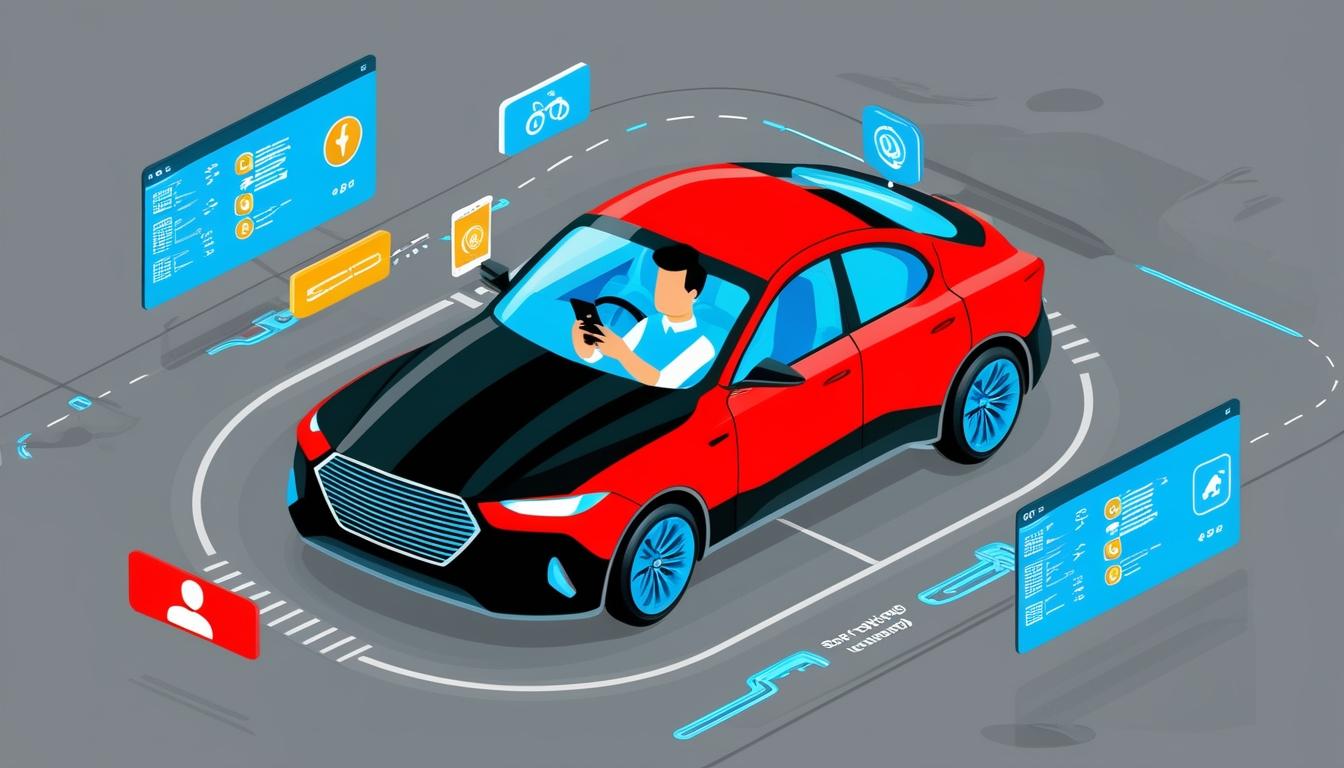

Research suggests that using mobile phones may not significantly impair reaction times for drivers of self-driving vehicles, prompting potential legal changes.
Motorists in the UK may soon be permitted to use their mobile phones while behind the wheel of self-driving vehicles, pending ongoing research and government assessments. Currently, autonomous vehicles in the UK can operate only in single-lane traffic conditions and are restricted to speeds below 37 miles per hour. This feature is primarily utilised during motorway traffic congestion, where drivers must be prepared to take manual control of the vehicle within a ten-second window if necessary.
Recent studies commissioned by the Government indicate that the reaction times of individuals engaging in mobile phone activities while driving may not be as impaired as previously thought. “Motorists were slower to react when playing on a phone than they were when drinking or reading a magazine,” as reported by the Mirror. Nevertheless, participants in the study were still able to regain control of the vehicle within the required timeframe.
Currently, UK law imposes a £200 fine and six penalty points for drivers caught using their phones while operating a vehicle, which remains illegal even when the self-driving systems are in use. However, it is legal for a vehicle equipped with automated lane-keeping technology to operate independently in specified conditions, allowing the user to disengage from active driving responsibilities when in a single-lane scenario under the set speed limit.
Under existing regulations referenced by the Telegraph, the Highway Code allows users to engage with in-vehicle entertainment systems and divert their attention from the road when automated lane-keeping technology is working, changing their designation from ‘driver’ to ‘user-in-charge.’ Despite this, activities deemed illegal by driving standards, such as phone usage, remain prohibited. This paradigm could shift following the latest research conducted by Loughborough University and University College London.

The Department for Transport (DfT) is pursuing a comprehensive understanding of driver interactions with self-driving vehicles while ensuring that road safety is paramount. Nearly 100 individuals participated in simulations designed to assess how quickly and effectively they could respond to regain control of the vehicle when prompted.
A spokesman for the DfT shared with the Telegraph, “Road safety is our absolute priority, and that’s why we commissioned this two-part study to fully understand how drivers interact with self-driving cars.” The government has indicated that self-driving technology is envisaged as a crucial component in their broader strategy to foster job creation and endorse future industries. Nevertheless, any revisions to existing regulations surrounding the use of automated vehicles will be meticulously evaluated to ensure that public safety remains uncompromised. Further details about the regulation and implementation of self-driving vehicles are anticipated to be announced in the near future.
Source: Noah Wire Services
- https://www.autonomousvehicleinternational.com/news/legislation/self-driving-vehicles-expected-on-uk-roads-by-2026-following-new-legislation.html – Corroborates the introduction of the Automated Vehicles (AV) Act, the expected rollout of self-driving vehicles on UK roads by 2026, and the focus on road safety and reducing human error.
- https://evmagazine.com/articles/self-driving-cars-on-uk-roads-by-2026-new-law-enacted – Supports the enactment of the Automated Vehicles (AV) Act and its aim to integrate self-driving cars into daily traffic with stringent safety standards.
- https://www.topgear.com/car-news/tech/self-driving-cars-could-be-uk-roads-2026-after-new-law-signed – Confirms the new legislation governing self-driving cars, the requirement for these vehicles to operate as safely as human drivers, and the restrictions on their operation.
- https://www.autonomousvehicleinternational.com/news/legislation/self-driving-vehicles-expected-on-uk-roads-by-2026-following-new-legislation.html – Details the current restrictions on autonomous vehicles, such as single-lane traffic conditions and speed limits, and the need for drivers to be prepared to take manual control.
- https://www.topgear.com/car-news/tech/self-driving-cars-could-be-uk-roads-2026-after-new-law-signed – Explains the distinction between ‘driver’ and ‘user-in-charge’ when automated lane-keeping technology is in use, and the current prohibition on phone usage.
- https://evmagazine.com/articles/self-driving-cars-on-uk-roads-by-2026-new-law-enacted – Highlights the UK’s commitment to innovation and safety in the automotive sector through the AV Act and its potential economic benefits.
- https://www.autonomousvehicleinternational.com/news/legislation/self-driving-vehicles-expected-on-uk-roads-by-2026-following-new-legislation.html – Mentions the Department for Transport’s role in ensuring road safety and the comprehensive legal framework introduced by the AV Act.
- https://www.topgear.com/car-news/tech/self-driving-cars-could-be-uk-roads-2026-after-new-law-signed – Supports the government’s focus on road safety and the evaluation of driver interactions with self-driving vehicles through studies.
- https://evmagazine.com/articles/self-driving-cars-on-uk-roads-by-2026-new-law-enacted – Discusses the broader goals of improving mobility and access to services, particularly in rural communities, through self-driving technology.
- https://www.autonomousvehicleinternational.com/news/legislation/self-driving-vehicles-expected-on-uk-roads-by-2026-following-new-legislation.html – Provides insights from industry figures and government officials on the significance of the AV Act and its potential to create jobs and boost the economy.