






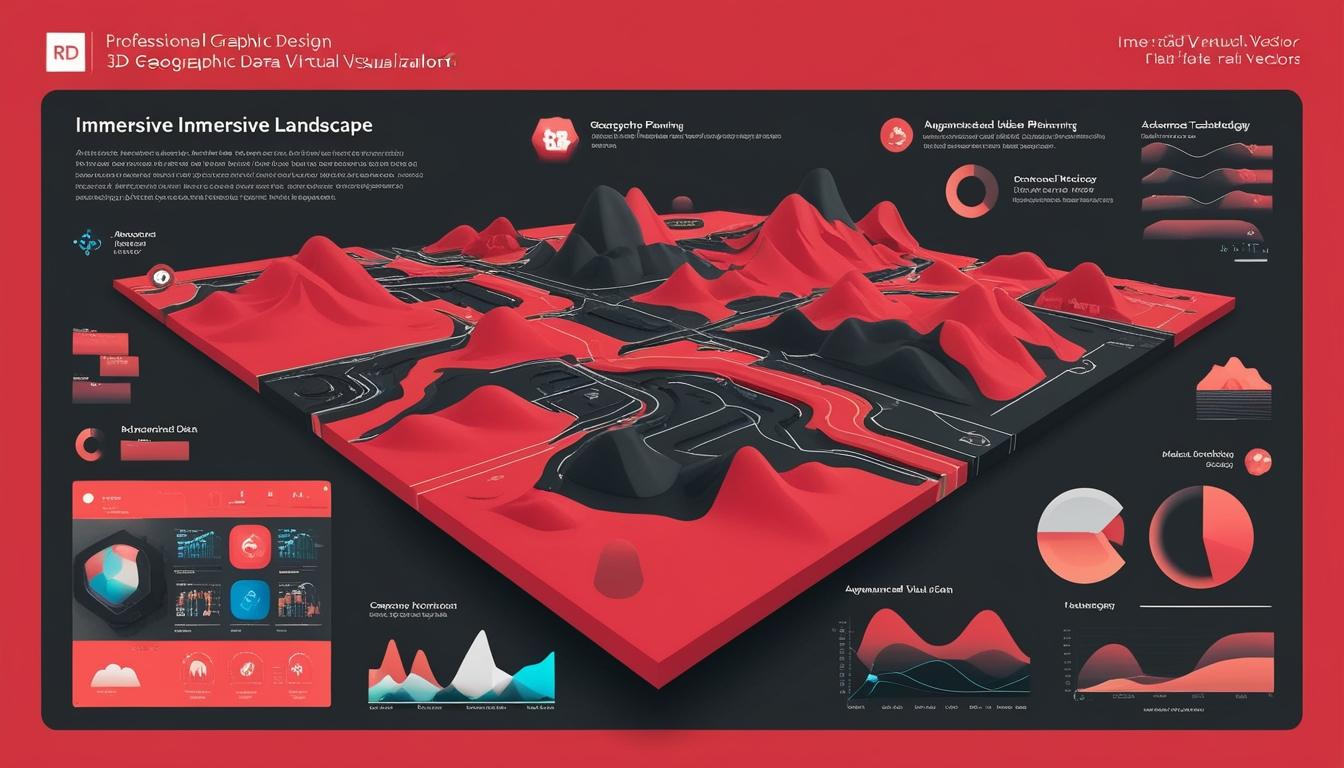

Advancements in immersive technologies are revolutionising spatial data visualization and interaction, with significant implications for urban planning, disaster management, and environmental monitoring.
The intersection of Virtual Reality (VR), Augmented Reality (AR), and Geographic Information Systems (GIS) is set to change the landscape of spatial data visualization and interaction, as detailed by technology researcher Arun Kumar Epuri in a recent discussion. This evolution in technology is reflecting broader trends, with GIS expected to expand into a market worth $17.5 billion by 2025 and the combined AR/VR sector forecasted to reach approximately $97.76 billion by 2028.
Historically, GIS has relied heavily on 2D maps and static visualisations. However, with the introduction of immersive technologies, users can now navigate 3D environments and engage with geographic information in a more intuitive and dynamic manner. This transition allows professionals in various fields, including urban planning and disaster management, to visualise complex scenarios like environmental changes or urban developments with unprecedented clarity.
Recent advancements have facilitated the integration of VR and AR within GIS, significantly improving performance metrics. Innovations have resulted in a 90% reduction in rendered polygons and a notable 60% decrease in load times, enhancing the real-time interaction with intricate geographic datasets. The inclusion of haptic feedback technology enables users to interact with virtual terrains tactilely, increasing task completion rates by 25%. Furthermore, the application of AI-driven visualisation techniques has effectively diminished the complexity of 3D models by 75%, all while preserving high visual quality, thus boosting the efficiency of immersive GIS tools.
The rollout of 5G technology is a crucial factor accelerating this progress. With speeds of up to 20 gigabits per second and nearly instantaneous response times, 5G networks allow for the rapid transfer of large datasets, transforming collaborative experiences in real-time VR. This is especially beneficial in fields such as urban planning and environmental monitoring.

The practical implications of immersive GIS technology are already being realised. For example, VR-enabled systems in urban planning have increased stakeholder engagement by 30%, providing a clearer understanding of complex designs. In disaster management, applications using AR have achieved remarkable efficiencies, with response times decreased by up to 40% during emergencies, thereby preserving resources and saving lives. Moreover, AR is facilitating advanced environmental monitoring, enabling dynamic analyses of changes in ecosystems and water resources.
Emerging applications of immersive GIS further illustrate its versatility, including transportation modelling, where AR can be employed to visualize traffic patterns and optimize routes, and renewable energy planning, which leverages GIS with VR to pinpoint ideal locations for solar or wind energy projects.
However, several challenges remain regarding the integration of VR and AR into GIS practices. Key obstacles cited include high costs, the accessibility of devices, a steep learning curve for new users, and concerns surrounding data privacy from substantial spatial datasets. High-performance hardware requirements also hinder widespread adoption. To counter these issues, there is a call for affordable, accessible solutions such as cloud-based platforms and streamlined AR/VR devices that would allow smaller businesses and regions with limited resources to access these transformative technologies.
Looking ahead, projections for the future of immersive GIS are ambitious. By 2030, the advent of quantum computing could vastly enhance GIS capabilities, enabling the processing of complex geographic algorithms at speeds up to 100,000 times faster than current technologies. Coupled with further advancements in AI and machine learning, future GIS systems could anticipate urban growth and disaster risks with pinpoint accuracy. By the year 2025, it is expected that 70% of urban planning projects will incorporate VR/AR technologies, a significant increase from less than 10% in 2021.
As emphasised by Arun Kumar Epuri, the advancements in VR and AR signify more than just technological improvements; they herald a fundamental shift in our understanding and interaction with geographic spaces. By effectively merging these immersive technologies with GIS, a new era in spatial analysis is emerging that promises to redefine not only specific industries but also the way individuals understand and interact with their environments.
Source: Noah Wire Services
- https://www.mdpi.com/2220-9964/13/7/241 – This article discusses the integration of VR and AR with GIS, highlighting how it revolutionizes data visualization, including the ability to navigate 3D environments and engage with geographic information dynamically.
- https://www.marketsandmarkets.com/Market-Reports/ar-vr-software-market-186416119.html – This report forecasts the combined AR/VR sector to reach approximately $77.5 billion by 2028, reflecting broader trends in the market expansion of AR and VR technologies.
- https://www.globenewswire.com/news-release/2023/11/01/2771367/0/en/Augmented-Reality-and-Virtual-Reality-Market-Growth-to-Hit-36-9-CAGR-Globally-by-2028-Exclusive-Report-by-The-Insight-Partners.html – This report provides a forecast for the AR and VR market, estimating it to reach $252.16 billion by 2028, and discusses the growth driven by various end-user industries.
- https://www.mdpi.com/2220-9964/13/7/241 – The article details innovations such as reduced rendered polygons and load times, and the inclusion of haptic feedback technology, which enhance the performance and user interaction with GIS data.
- https://www.mdpi.com/2220-9964/13/7/241 – It explains how AI-driven visualization techniques have simplified 3D models while maintaining high visual quality, boosting the efficiency of immersive GIS tools.
- https://www.globenewswire.com/news-release/2023/11/01/2771367/0/en/Augmented-Reality-and-Virtual-Reality-Market-Growth-to-Hit-36-9-CAGR-Globally-by-2028-Exclusive-Report-by-The-Insight-Partners.html – The rollout of 5G technology is highlighted as a crucial factor in accelerating the progress of immersive GIS, enabling rapid data transfer and real-time collaborative experiences.
- https://www.mdpi.com/2220-9964/13/7/241 – The practical implications of immersive GIS are discussed, including increased stakeholder engagement in urban planning and improved response times in disaster management.
- https://www.globenewswire.com/news-release/2023/11/01/2771367/0/en/Augmented-Reality-and-Virtual-Reality-Market-Growth-to-Hit-36-9-CAGR-Globally-by-2028-Exclusive-Report-by-The-Insight-Partners.html – Emerging applications such as transportation modelling and renewable energy planning are mentioned, illustrating the versatility of immersive GIS technology.
- https://www.mdpi.com/2220-9964/13/7/241 – Challenges in integrating VR and AR into GIS practices, including high costs, accessibility issues, and data privacy concerns, are addressed in this article.
- https://www.globenewswire.com/news-release/2023/11/01/2771367/0/en/Augmented-Reality-and-Virtual-Reality-Market-Growth-to-Hit-36-9-CAGR-Globally-by-2028-Exclusive-Report-by-The-Insight-Partners.html – Future projections include the potential impact of quantum computing and further AI advancements on GIS capabilities by 2030, enabling more accurate predictions and faster processing.







