






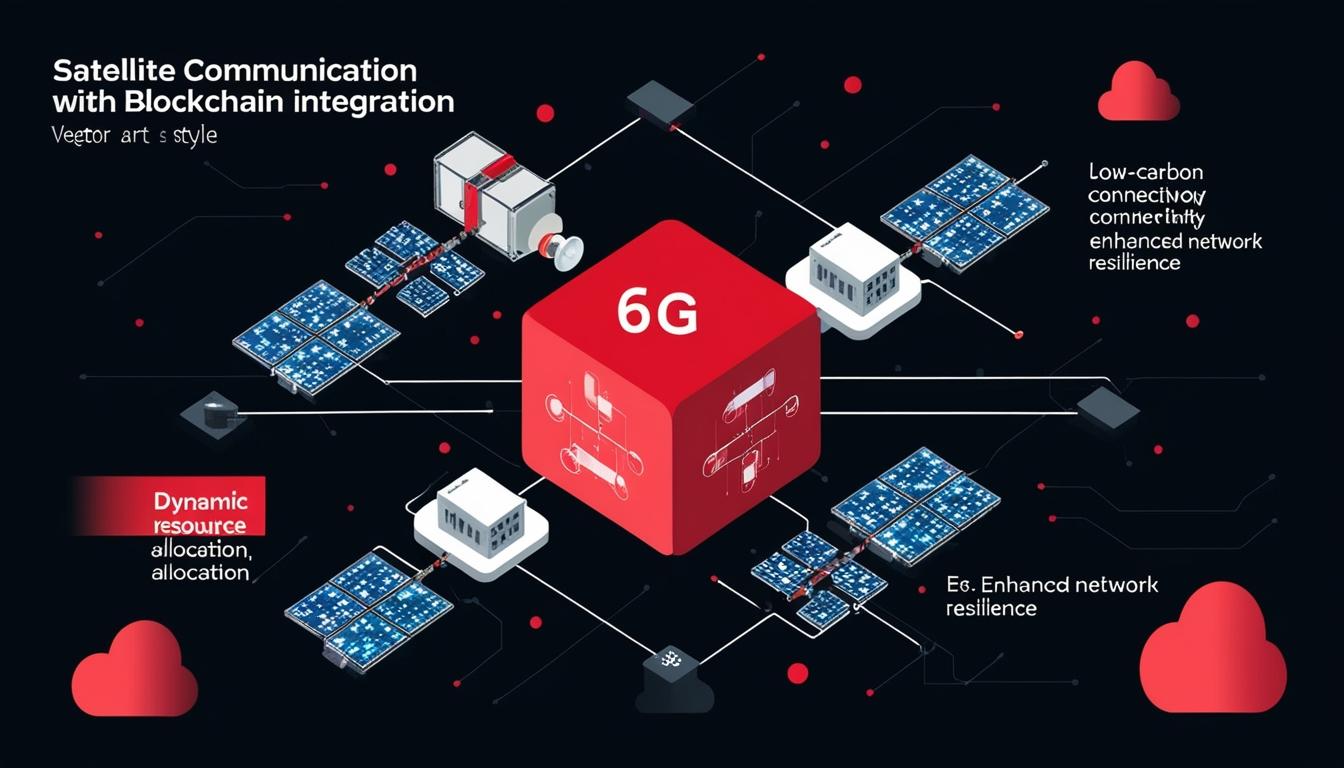

A recent study has highlighted the combination of satellite direct-to-device communication and blockchain tech, aiming to enhance efficiency and sustainability in 6G networks.
The IEEE Internet of Things Journal has reported on a significant advancement in telecommunications, showcasing a study that merges Satellite direct-to-device (D2D) communication with a federated multiagent deep reinforcement learning (DRL) framework, wherein blockchain technology plays a vital supportive role. This innovative approach has been designed with the goal of optimising network slicing capabilities specifically for Satellite D2D communications, while also prioritising low-carbon sustainable computing practices.
The central focus of this study is on how this federated multiagent-DRL framework can dynamically manage network slices, a key component in optimising resource allocation. The ability to ensure superior Quality of Service (QoS) for direct satellite links is particularly noteworthy, especially within the emerging context of 6G non-terrestrial networks (NTNs).
One of the primary benefits highlighted by the researchers is the capacity of Satellite D2D technology to enhance connectivity in remote areas. This capability not only addresses the prevalent challenges associated with connectivity but also aims to reduce latency, thereby improving overall network reliability and coverage.
Furthermore, the inclusion of blockchain technology within this framework adds layers of security and transparency, creating a decentralised learning environment that bolsters data integrity. As the telecommunications industry increasingly focuses on sustainable practices, the framework’s integration of low-carbon computing methods serves to reduce both energy consumption and carbon emissions, aligning with broader sustainability objectives.

Comprehensive simulations conducted as part of the study have demonstrated considerable enhancements in latency and throughput, alongside improved network resilience. These factors contribute to optimised resource utilisation, paving the way for the development of efficient and robust architectures within 6G NTN systems.
This research underscores the potential for advanced technologies to not only transform telecommunication practices but also to make strides toward environmentally sustainable solutions in this rapidly evolving sector.
Source: Noah Wire Services
- https://www.mdpi.com/2504-446X/8/10/532 – This article discusses the integration of high-altitude UAVs with satellite D2D communications for 6G IoT networks, highlighting the operational efficiency, broad coverage, and potential for transforming global communications, especially in remote areas.
- https://www.mdpi.com/2504-446X/8/10/532 – The study emphasizes the use of a federated multiagent deep reinforcement learning (DRL) framework for dynamic network slice management and resource allocation in satellite D2D communications.
- https://www.mdpi.com/2504-446X/8/10/532 – The article details how the framework ensures superior Quality of Service (QoS) for direct satellite links, particularly relevant in the context of 6G non-terrestrial networks (NTNs).
- https://www.mdpi.com/2504-446X/8/10/532 – It highlights the benefits of Satellite D2D technology in enhancing connectivity in remote areas, reducing latency, and improving network reliability and coverage.
- https://www.mdpi.com/2504-446X/8/10/532 – The inclusion of blockchain technology is discussed, adding layers of security and transparency to the framework, and creating a decentralized learning environment that bolsters data integrity.
- https://www.mdpi.com/2504-446X/8/10/532 – The study mentions the integration of low-carbon computing methods to reduce energy consumption and carbon emissions, aligning with broader sustainability objectives in the telecommunications industry.
- https://www.mdpi.com/2504-446X/8/10/532 – Comprehensive simulations are noted to have demonstrated enhancements in latency and throughput, as well as improved network resilience, contributing to optimized resource utilization.
- https://www.mdpi.com/2504-446X/8/10/532 – The research underscores the potential for advanced technologies to transform telecommunication practices and contribute to environmentally sustainable solutions.
- https://www.mdpi.com/2504-446X/8/10/532 – The article provides details on the system model, including IoT-focused network architecture, communication link models, and HA-UAV relaying schemes, which are crucial for the efficient operation of the proposed framework.
- https://www.mdpi.com/2504-446X/8/10/532 – It discusses the importance of resource allocation strategies and device association decisions in ensuring efficient network performance and minimizing latency.
- https://www.mdpi.com/2504-446X/8/10/532 – The study also mentions the dynamic adjustment of HA-UAV positions based on predicted traffic demands to ensure optimal coverage and minimize latency.







