






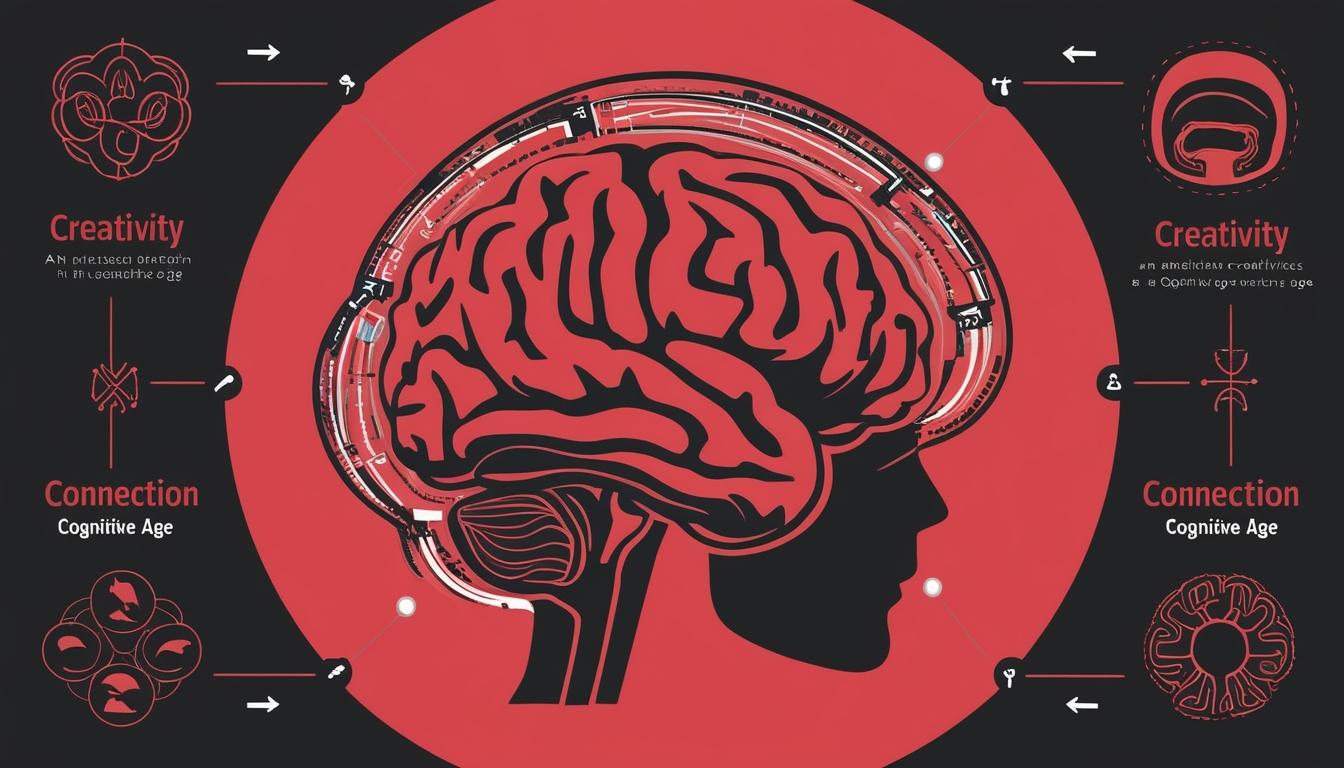
As we transition into an era defined by our understanding of thought, the role of artificial intelligence in shaping cognition is under scrutiny.
In recent discussions surrounding artificial intelligence (AI) and its transformative role in society, a significant emphasis has been placed on the evolution of cognition. As highlighted in a piece published by Psychology Today, we are entering what is being described as the Cognitive Age—an era defined not just by advancements in technology, but by the capacity to observe and understand the very mechanisms of thought itself.
The article delves into the historical context of human cognition, tracing its roots from primitive symbols used by early humans on cave walls to the profound complexity of modern AI systems. Early forms of communication, such as cave paintings and gestures, represented the initial attempts to encode meaning. These early symbols bridged personal experiences and collective understanding, paving the way for the development of spoken and written language. The significance is noted in how a word acts as a placeholder for abstract ideas, encapsulating broader meanings beyond the immediate.
With the advent of internet technologies like Google, the interpretation of knowledge underwent another shift. The ability to search and organise information moved us from mere words to well-structured facts, creating a foundation for more complex understandings of the world. Facts, while useful, are described as inadequate on their own to tackle the intricacies of human thought without the element of synthesis—the capacity to integrate and contextualise information creatively.
The article further explores how large language models (LLMs) play a pivotal role in this cognitive development. LLMs do not merely function as tools for retrieving facts but participate in the process of thought itself by synthesizing information into coherent outputs. This function illustrates a transformative capability, as these systems reflect the structure of human thought, inviting users to engage with knowledge in innovative ways. “LLMs act as a kind of cognitive mirror,” it states, shedding light on the interplay of symbols, words, facts, and thoughts.

The conceptual journey presented in the article is framed within a nested hierarchy of cognition. Philosopher Ken Wilber’s notion of a “holonic” structure portrays each layer—symbols, words, facts, and thoughts—not as isolated stages, but as interconnected domains that build upon one another. As this cognitive framework unfolds, it challenges traditional perspectives on intelligence, posing inquiries into how we conceive of creativity, connections, and knowledge.
As we navigate this Cognitive Age, there is a clear invitation to leverage our understanding of cognition in various spheres, from enhancing creativity and relationships to refining our grasp of purpose and efficiency. The idea is to not simply reduce thought processes to mechanistic outputs but to enrich them, expanding the scope of what it means to think and create.
In closing, the piece underscores a broader evolution—the shift from cognition to what is termed the “Aetas Mentis,” or Age of the Mind. This marks a transcendence beyond the mechanics of reasoning and into realms of creativity and connection. Here, contemplation is not limited to problem-solving; it ventures into the realms of aspiration and discovery, suggesting that human thought, while enhanced by AI, is ultimately a bridge to dimensions beyond what technology alone can define.
Source: Noah Wire Services
- https://www.unicef.org/innovation/sites/unicef.org.innovation/files/2018-11/Children%20and%20AI_Short%20Verson%20(3).pdf – This document from UNICEF discusses the impact of AI on children, including cognitive support, accessibility, and the broader implications on their development and rights, which aligns with the discussion on the evolution of cognition and AI’s role.
- https://www.weforum.org/stories/2024/01/this-is-the-one-skill-everybody-needs-in-the-age-of-ai/ – This article from the World Economic Forum highlights the need for critical thinking and continuous learning in the age of AI, reflecting the shift in cognitive skills required in the Cognitive Age.
- https://www.weforum.org/stories/2024/01/this-is-the-one-skill-everybody-needs-in-the-age-of-ai/ – The article discusses how AI is transforming jobs and the importance of adapting education to include AI education, which is relevant to the discussion on the cognitive development and the role of AI.
- https://www.unicef.org/innovation/sites/unicef.org.innovation/files/2018-11/Children%20and%20AI_Short%20Verson%20(3).pdf – This document explores the cognitive and psychological implications of AI on children, including how AI affects their brain and psychological well-being, aligning with the discussion on the mechanisms of thought.
- https://www.weforum.org/stories/2024/01/this-is-the-one-skill-everybody-needs-in-the-age-of-ai/ – The article mentions the comparison of AI to historical technological advancements like the steam engine, highlighting its transformative impact on society and cognition.
- https://www.unicef.org/innovation/sites/unicef.org.innovation/files/2018-11/Children%20and%20AI_Short%20Verson%20(3).pdf – This document discusses the role of AI in enhancing accessibility and cognitive support, which is part of the broader cognitive development discussed in the article.
- https://www.weforum.org/stories/2024/01/this-is-the-one-skill-everybody-needs-in-the-age-of-ai/ – The article emphasizes the need for analytical and creative thinking in the age of AI, reflecting the synthesis and contextualization of information discussed in the Cognitive Age.
- https://www.unicef.org/innovation/sites/unicef.org.innovation/files/2018-11/Children%20and%20AI_Short%20Verson%20(3).pdf – This document explores the nested hierarchy of cognition and how AI impacts various aspects of children’s lives, including education and health, which aligns with the concept of interconnected domains of cognition.
- https://www.weforum.org/stories/2024/01/this-is-the-one-skill-everybody-needs-in-the-age-of-ai/ – The article discusses the importance of continuous learning and adapting to change, which is crucial in the Cognitive Age and the transition to the Age of the Mind.
- https://www.unicef.org/innovation/sites/unicef.org.innovation/files/2018-11/Children%20and%20AI_Short%20Verson%20(3).pdf – This document highlights the need to ensure that AI enhances human thought and creativity rather than reducing it to mechanistic outputs, aligning with the aspiration and discovery aspects of the Age of the Mind.
- https://www.weforum.org/stories/2024/01/this-is-the-one-skill-everybody-needs-in-the-age-of-ai/ – The article underscores the broader evolution and the need for a populace that can adapt to change, reflecting the transcendence beyond mere cognition to realms of creativity and connection.







