





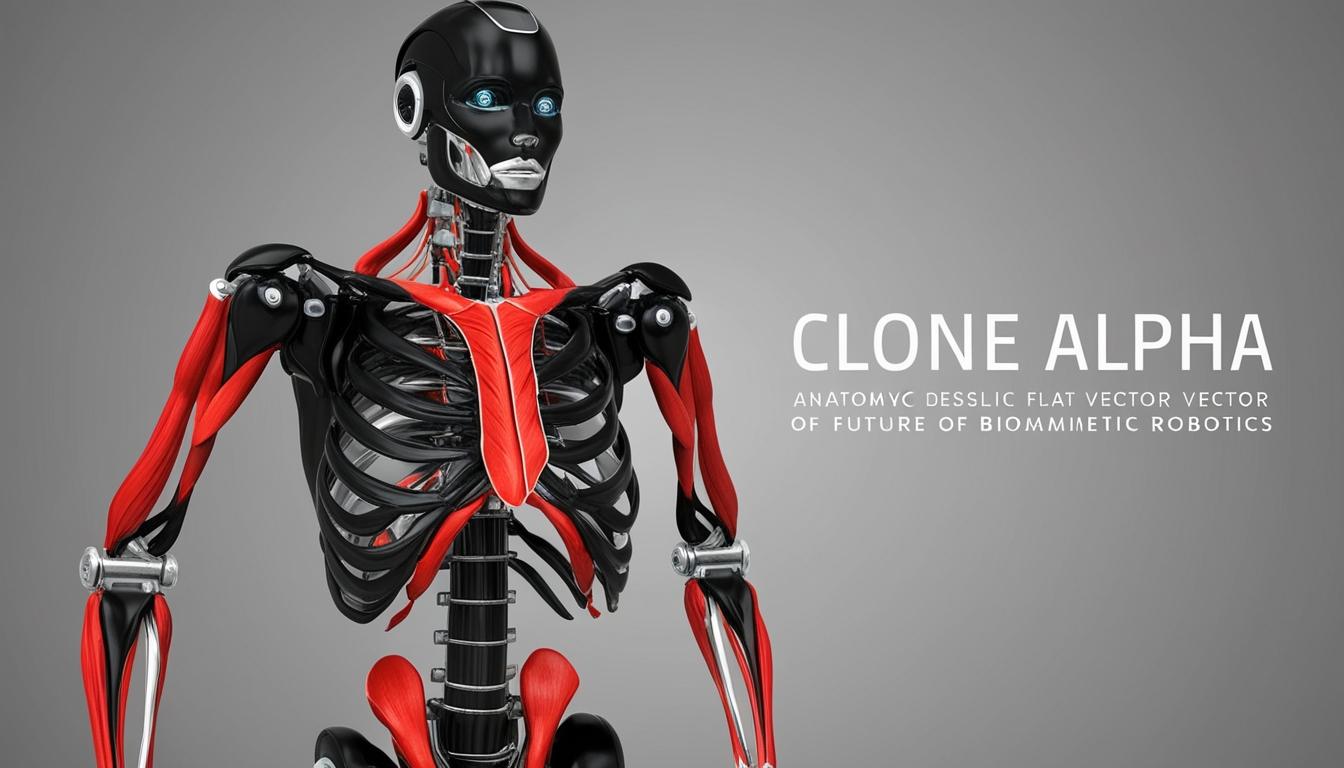

Clone Robotics has introduced Clone Alpha, a groundbreaking humanoid robot featuring synthetic organs and advanced motion capabilities.
Clone Robotics, a company based in Poland with a focus on biomimetic robotics, has recently unveiled its inaugural full-scale humanoid robot, Clone Alpha. This innovative android marks a significant advancement in the field of humanoid robotics, as it incorporates synthetic organs, artificial muscles, and a skeletal framework that parallels human anatomy. The aim of this groundbreaking project is to push the boundaries of what is possible in humanoid robotics.
The company’s approach to replicating human dexterity and strength is based on a departure from traditional robotic design. By using a methodology that mimics human anatomy, Clone Robotics intends to enhance the robot’s motion capabilities significantly.
At the heart of Clone Alpha’s performance is Myofiber, a proprietary technology for artificial muscles that the company introduced in 2021. These water-powered muscles connect to the skeleton at anatomically precise points, enabling the imitation of critical mammalian muscle properties, including rapid response times, significant contraction force, and efficient energy consumption. This system allows for the animation of a full human-like skeleton comprising 206 bones, along with minor fusions and completely articulated joints. Notably, the robot is designed to provide up to 164 degrees of freedom in its upper torso, resulting in a movement range that closely resembles human mobility.
The design of Clone Alpha also features a complex nervous system, which includes 70 inertial sensors for monitoring joint movement and 320 pressure sensors for evaluating muscle force. To enhance its sensory capabilities, the robot is equipped with visual input from four depth cameras. Data processing in Clone Alpha is powered by NVIDIA’s Jetson Thor GPU, utilising Clone’s Cybernet model. Furthermore, a compact electric pump simulates the function of a human heart, delivering hydraulic pressure through an innovative Aquajet valve system that effectively actuates the muscle components.

While Clone Robotics has revealed several compelling features of Clone Alpha, including its humanoid torso and lifelike movement capabilities, the company has not yet showcased a fully operational version of the robot. The transition from prototype to complete systems will serve as a critical test of the scalability of their technology.
In a strategic move to establish itself in the highly competitive humanoid robotics market, Clone Robotics has opened pre-orders for 279 units via its official website. The company aims to provide unmatched realism and functionality in artificial beings, potentially reshaping the landscape of robotics in the future.
Source: Noah Wire Services
- https://www.sciencedaily.com/releases/2024/02/240226114557.htm – This article discusses the use of ultraviolet-laser processing for fabricating biomimetic robots with life-like movement, which is relevant to the development of artificial muscles and biohybrid actuators in humanoid robotics.
- https://academic.oup.com/nsr/article/11/10/nwae232/7708368?login=false – This article details the advancements in artificial muscle fibers, including their mechanical properties and actuation capabilities, which align with the concept of synthetic organs and artificial muscles in humanoid robots.
- https://www.azorobotics.com/news-category.aspx?CatID=8 – This page discusses various innovations in biomimetic robotics, including the development of bio-inspired soft robots and advanced actuation systems, which are relevant to the technological advancements in humanoid robotics.
- https://www.sciencedaily.com/releases/2024/02/240226114557.htm – This article highlights the importance of muscle cell alignment in biohybrid actuators, which is crucial for achieving life-like movements in humanoid robots.
- https://academic.oup.com/nsr/article/11/10/nwae232/7708368?login=false – This article explains the benefits of electrically powered artificial muscles, including fine control, rapid response times, and compactness, all of which are desirable features in humanoid robotics.
- https://www.azorobotics.com/news-category.aspx?CatID=8 – This page mentions the development of a bionic spine for soft robots, which integrates sensing and actuation, similar to the complex nervous system and sensory capabilities described in Clone Alpha.
- https://academic.oup.com/nsr/article/11/10/nwae232/7708368?login=false – This article discusses the structural adaptability and mechanical performance of artificial muscle fibers, which are key aspects in replicating human dexterity and strength in humanoid robots.
- https://www.sciencedaily.com/releases/2024/02/240226114557.htm – This article describes the use of UV-laser processing for creating intricate microstructures, which could be relevant to the precise anatomical design of Clone Alpha’s skeletal framework.
- https://academic.oup.com/nsr/article/11/10/nwae232/7708368?login=false – This article mentions the integration of sensing capabilities into artificial muscle fibers, similar to the sensory system described in Clone Alpha, including inertial and pressure sensors.
- https://www.azorobotics.com/news-category.aspx?CatID=8 – This page discusses the use of advanced materials and technologies in biomimetic robotics, such as lead zirconate titanate (PZT), which could be relevant to the materials and technologies used in Clone Alpha.







