






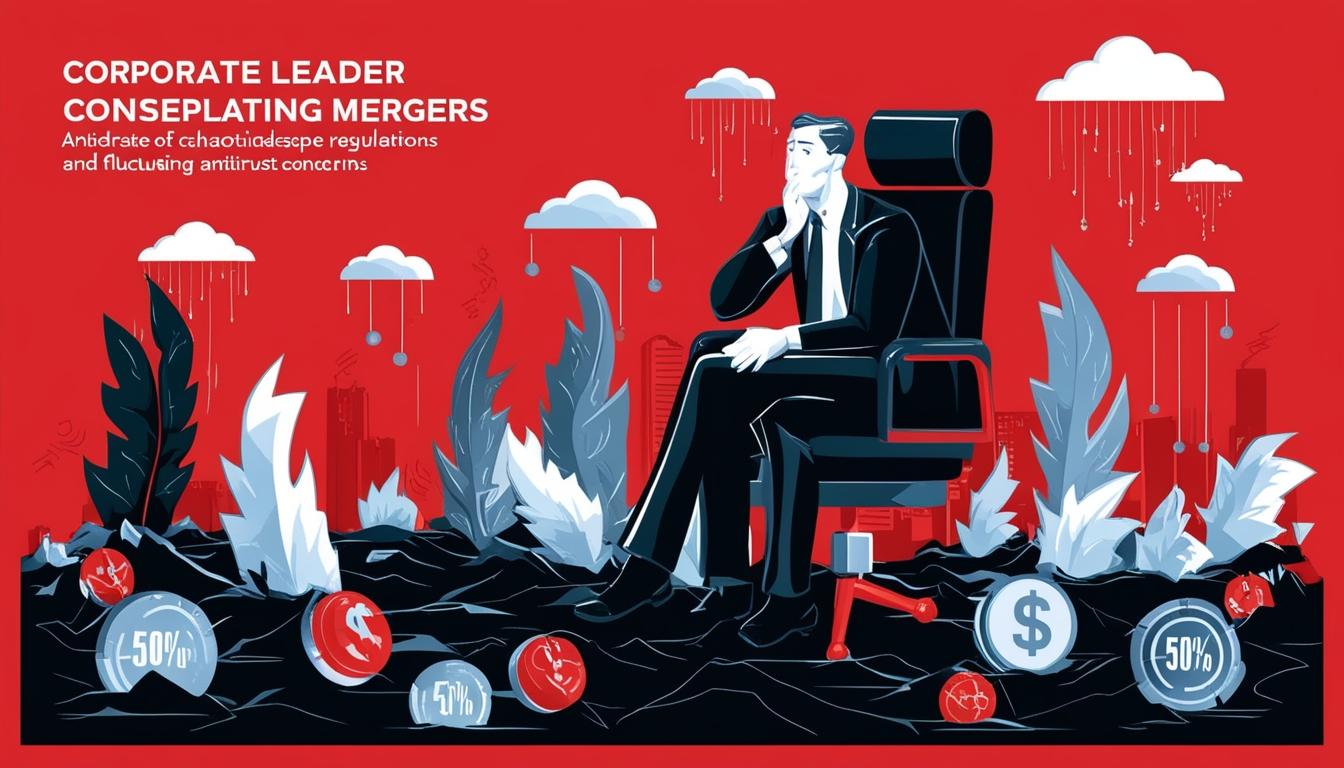

Following the election results, corporate leaders are contending with the prospect of significant changes in antitrust enforcement that could impact mergers and acquisitions across various sectors.
Following the recent election results, corporate leaders express a heightened sense of anticipation over the potential for significant mergers and acquisitions, especially in sectors such as technology, media, and finance. This optimism is reportedly influenced by expectations of a reduction in the strict regulatory measures enforced by the outgoing Biden administration, particularly concerning antitrust laws.
As business executives contemplate the prospects of a second term under Donald Trump, they face a complex and uncertain landscape regarding antitrust enforcement. During the first Trump administration, the approach to competition regulation was often characterised by unpredictability, raising questions about the implications for businesses moving forward. Specifically, Trump’s tenure saw a blend of antitrust policy that was sometimes driven by personal bias and political affiliation rather than consistent legal standards.
Notably, Trump’s decision-making has previously appeared capricious, as evidenced by actions taken by his Department of Justice to block the AT&T and Time Warner merger, seemingly influenced by a desire to retaliate against CNN’s coverage. In contrast, the approval of Disney’s acquisition of 21st Century Fox underscored a selective enforcement that appeared to favour certain corporate interests. Analysts suggest that such a volatile approach to antitrust issues could stifle innovation, as businesses may become more risk-averse under the threat of political reprisals.
Currently, the landscape presents varying perspectives among corporate leaders. Some have expressed unease about the potential for the new administration to implement a form of industrial policy driven by political loyalties rather than objective regulatory standards. There is concern that the unpredictability of Trump’s leadership could discourage businesses from pursuing ambitious innovations due to fears of arbitrary enforcement actions.

Historically, the effects of relaxed antitrust enforcement—such as those seen from 1981 onwards—did not yield the anticipated economic prosperity. The data indicates that the period between 1950 and 1980, characterised by stricter regulatory frameworks, resulted in higher economic growth rates compared to the years of increased concentration during the subsequent era. The anticipated shift towards a less regulated environment under a second Trump administration raises alarms among some experts who argue that this could perpetuate issues associated with monopoly power and reduced competition.
While Vice President-elect J.D. Vance has expressed support for a firm antitrust policy and acknowledged the role of current regulators in pursuing cases against tech giants, skepticism remains regarding the impartiality of future regulatory efforts under Trump. There are concerns that preferences may skew towards corporations with established political connections, particularly those aligned with Republican interests, leaving less room for unbiased scrutiny of monopolistic practices across the board.
These potential developments in antitrust enforcement may have widespread implications not just for consumers—who may face limited choices and increased prices—but also for employees, particularly regarding employment agreements that restrict mobility and wages. As the business community gears up for this anticipated transition, the overarching consensus appears to underscore the importance of stable, impartial regulations that encourage competition rather than submission to political whims. The future landscape for businesses may hinge on the administration’s approach to antitrust laws and regulatory oversight in the face of evolving technological advancements and market dynamics.
Source: Noah Wire Services
- https://dealroom.net/blog/upcoming-m-a – Provides context on upcoming M&A deals in 2024, including those in technology, media, and finance, which aligns with the anticipation of corporate leaders.
- https://dealroom.net/blog/recent-m-a-deals – Details recent and upcoming M&A deals, reflecting the optimism and activity in various sectors such as technology, media, and finance.
- https://kpmg.com/us/en/articles/2024/ma-outlook-corporate-deal-makers.html – Discusses the 2024 M&A outlook, including the impact of regulatory oversight and economic conditions, which are relevant to the anticipation and uncertainty around antitrust enforcement.
- https://www.citizensbank.com/corporate-finance/insights/mergers-acquisitions-outlook-2024.aspx – Outlines the optimistic outlook for M&A in 2024, influenced by economic prospects and easing market headwinds, which contrasts with the uncertainty around antitrust policies.
- https://www.bcg.com/publications/2024/m-and-a-market-insights-series-h1-2024 – Provides insights into the M&A market’s current activity and trends, including the impact of regulatory and economic factors, which are crucial for understanding the future landscape.
- https://www.reuters.com/article/us-usa-trump-antitrust-idUSKBN1XG1P8 – Reports on Trump’s antitrust policies during his first administration, highlighting the unpredictability and selective enforcement that raised concerns among businesses.
- https://www.nytimes.com/2019/02/26/business/dealbook/att-time-warner-merger.html – Details the DOJ’s block of the AT&T and Time Warner merger, illustrating the capricious nature of Trump’s antitrust decisions.
- https://www.wsj.com/articles/disney-fox-deal-gets-justice-department-approval-11547644401 – Covers the approval of Disney’s acquisition of 21st Century Fox, highlighting the selective enforcement of antitrust laws under Trump.
- https://www.economist.com/finance-and-economics/2020/01/16/the-effects-of-relaxed-antitrust-enforcement – Analyzes the historical effects of relaxed antitrust enforcement, comparing economic growth rates during different regulatory periods.
- https://www.brookings.edu/research/the-impact-of-antitrust-policy-on-economic-growth/ – Examines the impact of antitrust policy on economic growth, supporting the argument that stricter regulatory frameworks can lead to higher economic growth rates.
- https://www.politico.com/news/2024/11/jd-vance-antitrust-policy-00084351 – Reports on Vice President-elect J.D. Vance’s stance on antitrust policy, highlighting the ongoing skepticism about the impartiality of future regulatory efforts under Trump.







