





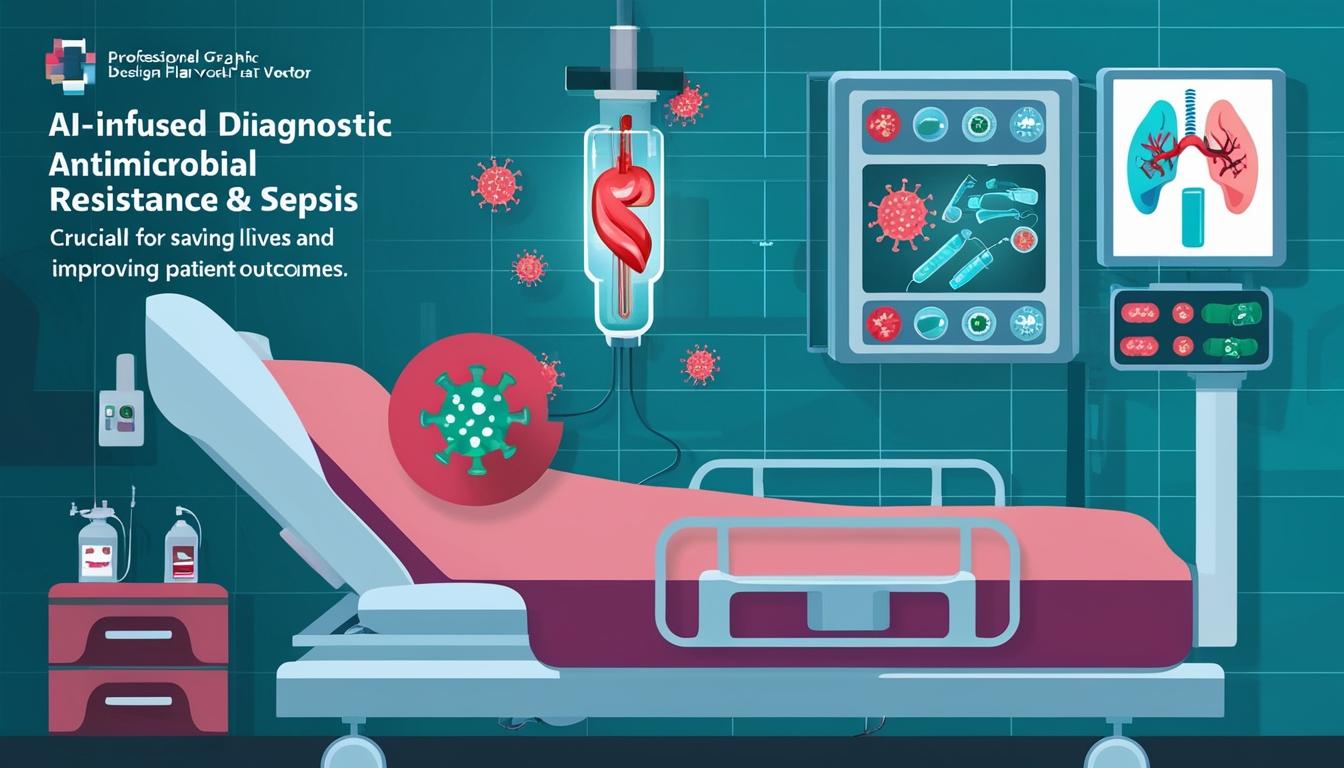

A pioneering study from King’s College London leverages artificial intelligence to provide faster diagnostics for sepsis-causing infections, addressing a critical healthcare challenge.
Antimicrobial resistance (AMR), characterised by microorganisms evolving defences against pharmaceutical treatments, continues to be a major global health challenge. The World Health Organisation estimates that AMR causes approximately 1.2 million deaths globally each year. Furthermore, the strain on healthcare systems is considerable, costing the National Health Service (NHS) in the UK an estimated £180 million annually. A particular concern arises when bloodstream infections become resistant to antibiotics, potentially leading to the severe condition of sepsis. Sepsis dramatically increases the risk of organ failure, shock, and death, making timely and accurate diagnosis crucial for patient survival.
Addressing this urgent healthcare problem, scientists from King’s College London, in collaboration with clinicians at Guy’s and St Thomas’ NHS Foundation Trust, have turned to artificial intelligence (AI) and machine learning to revolutionise the assessment of antimicrobial resistance in intensive care units (ICUs). The interdisciplinary team has been working on an innovative study that aims to improve the outcomes of critically ill patients by identifying sepsis-causing bloodstream infections more promptly and accurately.
Traditional methods of assessing ICU patients involve lengthy laboratory tests that require the growth of bacterial cultures, a process that can take up to five days. This delay can significantly affect care outcomes, especially in ICUs where patients already face life-threatening conditions. By integrating AI into this process, the researchers have demonstrated the potential for same-day triaging of ICU patients. This approach not only promises faster results but is also more cost-effective than conventional manual testing methods.
David Ferrari, a leading researcher from King’s College London and the study’s first author, highlighted the significance of these findings. He remarked, “Our study provides further evidence on the benefits of AI in healthcare, particularly relating to antimicrobial resistance and bloodstream infections. By streamlining the diagnostic process, AI can serve as a crucial tool for clinicians, helping them make informed decisions swiftly, which is vital in ICU settings.”

Dr Lindsey Edwards, a microbiology expert at King’s College London, emphasized that protecting existing antibiotics is essential in tackling AMR. The rapid diagnostic capabilities offered by AI could prevent inappropriate use of broad-spectrum antibiotics, reducing the risk of developing further resistance. Edwards noted, “Our findings indicate that AI diagnostics could significantly enhance patient survival rates and preserve the efficacy of current antibiotics.”
The research utilised data from 1,142 patients at Guy’s and St Thomas’ NHS Foundation Trust and has laid the groundwork for further studies that will involve datasets from over 20,000 individuals. There is optimism that the novel AI approach, particularly through Federated Machine Learning involving multiple hospitals, might meet the necessary regulatory standards for deployment across the NHS.
Professor Yanzhong Wang from King’s College London hailed the AI solution’s simplicity and scalability, suggesting that its widespread implementation could address critical healthcare challenges, ultimately improving patient outcomes on a broader scale. The promising results of this study underline the potential for AI to play a pivotal role in battling antimicrobial resistance globally, ensuring timely and accurate treatments for critically ill patients in intensive care settings.
Source: Noah Wire Services
More on this & verification
- https://www.who.int/news-room/fact-sheets/detail/antimicrobial-resistance – Corroborates the global health challenge posed by antimicrobial resistance and the estimated deaths caused by AMR.
- https://www.who.int/news-room/articles-detail/global-antimicrobial-resistance-forum-launched-to-help-tackle-common-threat-to-planetary-health – Provides details on the global impact of AMR, including the number of deaths and the economic costs associated with it.
- https://www.who.int/news-room/fact-sheets/detail/antimicrobial-resistance – Explains the strain on healthcare systems due to AMR and the potential for severe conditions like sepsis from resistant bloodstream infections.
- https://pmc.ncbi.nlm.nih.gov/articles/PMC4768623/ – Discusses the health and economic impact of antibiotic resistance, including the challenges in healthcare systems.
- https://www.thelancet.com/journals/lancet/article/PIIS0140-6736(21)02724-0/fulltext – Highlights the global burden of bacterial antimicrobial resistance and its implications for healthcare.
- https://www.who.int/news-room/fact-sheets/detail/antimicrobial-resistance – Details the importance of timely and accurate diagnosis in treating sepsis caused by antimicrobial-resistant infections.
- https://archive.cdc.gov/www_cdc_gov/drugresistance/us-activities/amr-challenge.html – Mentions the global efforts to address AMR, including the use of innovative approaches like AI and machine learning.
- https://www.who.int/news-room/articles-detail/global-antimicrobial-resistance-forum-launched-to-help-tackle-common-threat-to-planetary-health – Emphasizes the need for protecting existing antibiotics and preventing inappropriate use to reduce the risk of further resistance.
- https://pmc.ncbi.nlm.nih.gov/articles/PMC4768623/ – Discusses the importance of surveillance and data collection in addressing AMR, which aligns with the use of AI for diagnostic purposes.
- https://www.thelancet.com/journals/lancet/article/PIIS0140-6736(21)02724-0/fulltext – Highlights the need for comprehensive data and studies to understand and address the global burden of AMR.
- https://archive.cdc.gov/www_cdc_gov/drugresistance/us-activities/amr-challenge.html – Details global initiatives and collaborations to combat AMR, which could include the integration of AI solutions in healthcare settings.







